
|
You entered: Observatory
 Aurora Australis
4.07.2015
Not fireworks, these intense shimmering lights still danced across Earth's night skies late last month, seen here above the planet's geographic south pole. The stunning auroral displays were triggered as a coronal mass ejection blasted from the Sun days earlier impacted the magnetosphere, beginning a widespread geomagnetic storm.
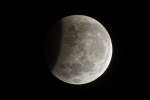 August Lunar Eclipse
9.08.2017
August's Full Moon is framed in this sharp, high dynamic range composition. Captured before sunrise on August 8 from Sydney, Australia, south is up and the Earth's dark, umbral shadow is at the left, near the maximum phase of a partial lunar eclipse.
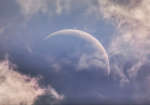 APOD: 2026 June 20 Б Daytime Moon Meets Evening Star
20.06.2026
Venus is now appearing on the celestial stage as Earth's brilliant evening star, performing with the Moon, other wandering planets, and bright stars in western skies. For evening sky gazers on June 17, the celestial beacon rose after sunset close by a young, slender, crescent Moon.
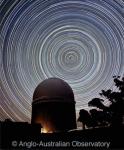 Star Trails in Southern Skies
15.07.2000
As the Earth spins on its axis, the stars seem to rotate around us. This motion produces the beautiful concentric arcs traced out by the stars in this time exposure of the southern hemisphere night sky. In the foreground is the dome of the Anglo-Australian Telescope in central New South Wales, Australia.
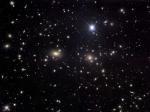 The Coma Cluster of Galaxies
21.03.2006
Almost every object in the above photograph is a galaxy. The Coma Cluster of Galaxies pictured above is one of the densest clusters known - it contains thousands of galaxies. Each of these galaxies houses billions of stars - just as our own Milky Way Galaxy does.
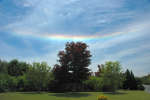 A Fire Rainbow Over New Jersey
10.06.2008
What is that inverted rainbow in the sky? Sometimes known as a fire rainbow for its flame-like appearance, a circumhorizon arc is created by ice, not fire. For a circumhorizon arc to be visible, the Sun must be at least 58 degrees high in a sky where cirrus clouds are present.
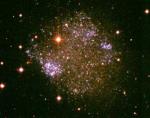 Irregular Galaxy Sextans A
14.11.1997
Grand spiral galaxies often seem to get all the glory. Their newly formed, bright, blue star clusters found along beautiful, symmetric spiral arms are guaranteed to attract attention. But small irregular galaxies form stars too, like this lovely, gumdrop-shaped galaxy, Sextans A.
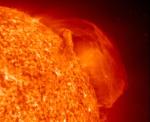 Erupting Sun
18.09.1997
On August 27th twisting magnetic fields propelled this huge eruptive prominence a hundred thousand miles above the Sun's surface. The seething plasma of ionized gases is at a temperature of about 150,000 degrees Farenheit and spans over 200,000 miles (about 27 Earths).
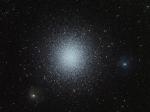 M13: The Great Globular Cluster in Hercules
11.05.2004
M13 is one of the most prominent and best known globular clusters. Visible with binoculars in the constellation of Hercules, M13 is frequently one of the first objects found by curious sky gazers seeking celestials wonders beyond normal human vision.
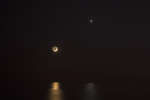 Reflections of Venus and Moon
19.05.2018
Posing near the western horizon, a brilliant evening star and slender young crescent shared reflections in a calm sea last Thursday after sunset. Recorded in this snapshot from the Atlantic beach at Santa Marinella...
|
January February March April May June July August September October |
|||||||||||||||||||||||||||||||||||||||||||||||||