
|
You entered: Observatory
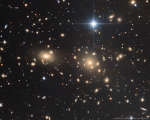 The Coma Cluster of Galaxies
26.03.2018
Almost every object in the above photograph is a galaxy. The Coma Cluster of Galaxies pictured here is one of the densest clusters known - it contains thousands of galaxies. Each of these galaxies houses billions of stars - just as our own Milky Way Galaxy does.
 A Thousand Meteors
12.09.2020
Over a thousand meteors flash through the night in this intriguing timelapse video. Starting in April 2019 the individual video frames were selected from 372 relatively clear nights of imaging from an automated wide-field observatory in rural New South Wales Australia.
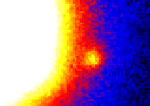 GL 229B: An Elusive Brown Dwarf?
4.12.1995
What type of matter makes up most of the universe? This question is arguably the most perplexing astronomical mystery of our time. A leading candidate is a type of dim, low mass star called a "brown dwarf" star.
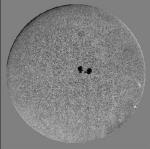 Grey Sun Seething
8.01.1997
The Sun's surface is not smooth. It has thousands of bumps called granules and usually a few dark depressions called sunspots. Each of the numerous granules is the size of an Earth continent, but much shorter lived.
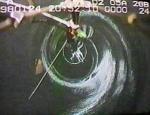 Ice Fishing for Cosmic Neutrinos
17.03.1999
In 1996, scientists melted a hole in the bottom of the world. In fact, several holes have been melted near the South Pole, and they are now being used as astronomical observatories. Astronomers with the Antarctic Muon and Neutrino Detector Array (AMANDA) lower into each vertical lake a string knotted with basketball-sized light detectors.
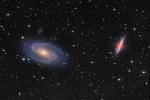 Galaxy Wars: M81 versus M82
15.04.2006
In this stunning cosmic vista, galaxy M81 is on the left surrounded by blue spiral arms. On the right marked by massive gas and dust clouds, is M82. These two mammoth galaxies have been locked in gravitational combat for the past billion years.
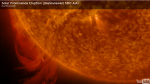 A Huge Solar Filament Erupts
31.07.2016
Filaments sometimes explode off the Sun. Featured, a huge filament had been seen hovering over the Sun's surface for over a week before it erupted late in 2010. The image sequence was taken by the Earth-orbiting Solar Dynamics Observatory (SDO) in one color of ultraviolet light.
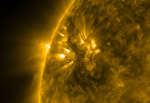 Dark Filament of the Sun
22.05.2010
Suspended by magnetic fields above a solar active region this dark filament stretches over 40 earth-diameters. The ominous structure appears to be frozen in time near the Sun's edge, but solar filaments are unstable and often erupt.
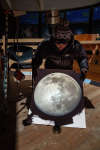 Direct Projection: The Moon in My Hands
28.02.2022
You don't have to look through a telescope to know where it's pointing. Allowing the telescope to project its image onto a large surface can be useful because it dilutes the intense brightness of very bright sources. Such dilution is useful for looking at the Sun, for example during a solar eclipse.
 APOD: 2023 April 3 Б The Galactic Center Radio Arc
3.04.2023
What causes this unusual curving structure near the center of our Galaxy? The long parallel rays slanting across the top of the featured radio image are known collectively as the Galactic Center Radio Arc and point out from the Galactic plane.
|
January February March April May June July August September October |
|||||||||||||||||||||||||||||||||||||||||||||||||