
|
You entered: Observatory
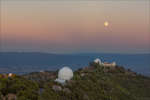 Solstice Dawn and Full Moonset
23.06.2016
A Full Moon sets as the Solstice Sun rises in this June 20 dawn skyscape. Captured from a nearby peak in central California, planet Earth, the scene looks across the summit of Mount Hamilton and Lick Observatory domes on a calendar date that marks an astronomical change of seasons and hemispherical extremes of daylight hours.
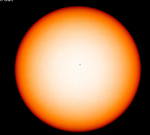 Mercury Crosses a Quiet Sun
2.12.2019
What's that black dot crossing the Sun? The planet Mercury. Mercury usually passes over or under the Sun, as seen from Earth, but last month the Solar System's innermost planet appeared to go just about straight across the middle.
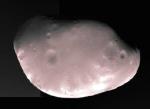 Deimos: A Small Martian Moon
15.11.1998
Mars has two tiny moons, Phobos and Deimos. Pictured above is Deimos, the smaller moon of Mars. In fact, Deimos is one of the smallest known moons in the Solar System measuring only 9 miles across.
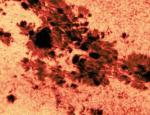 Sunspots: Magnetic Depressions
13.01.1997
Our Sun has spots! These spots appear dark in photographs like the one above, but in fact sunspots are quite bright - they are just dark compared to the rest of the Sun. Sunspots are about the size of the Earth and frequently occur in groups, as shown above.
 Children of the Sun
16.11.2006
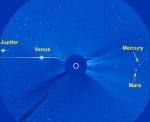
For a moment, planets Jupiter, Venus, Mars, and Mercury all posed near their parent star in this Sun-centered view, recorded on November 11. The picture, from a coronograph onboard the space-based SOlar Heliospheric Observatory, spans 15 degrees with the Sun's size and position indicated by the white circle.
 Advanced LIGO: Gravitational Wave Detectors Upgraded
7.02.2016
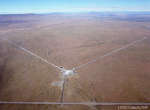
Accelerate a charge and you'll get electromagnetic radiation: light. But accelerate any mass and you'll get gravitational radiation. Light is seen all the time, but, so far, a confirmed direct detection of gravitational radiation has been elusive.
 Hauoli Makahiki Hou
4.01.2006
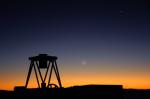
Fading sunlight, a young crescent Moon, and brilliant Venus shared the western sky in this view of 2005's final sunset from the top of Mount Haleakala, on Maui, Hawaii. Also known as the Sacred House of the Sun, Haleakala, is Maui's dormant volcano.
 The Antennae
30.06.2006
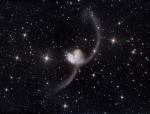
Some 60 million light-years away in the southerly constellation Corvus, two large galaxies have collided. But stars in the two galaxies - NGC 4038 and NGC 4039 - don't collide in the course of the ponderous, billion year or so long event.
 Follow The Spots
21.10.1999
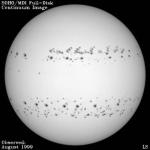
The Sun rotates on its axis about once every 27 days. How can you tell? Just follow the sunspots. This composite picture was constructed from solar images recorded daily by the MDI instrument on board the space-based SOlar and Heliospheric Observatory (SOHO).
 The Iron Sun
29.09.2001
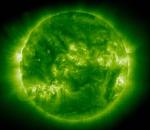
The ultraviolet light emitted by eleven times ionized iron at temperatures over 2 million degrees Farenheit was used to record the above picture of the Sun on September 22, the date of the autumnal equinox.
|
January February March April May June July August September October |
|||||||||||||||||||||||||||||||||||||||||||||||||