
|
You entered: Observatory
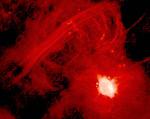 The Galactic Center Radio Arc
21.05.2002
What causes this unusual structure near the center of our Galaxy? The long parallel rays slanting across the top of the above radio image are known collectively as the Galactic Center Radio Arc and jut straight out from the Galactic plane.
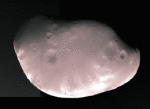 Deimos: Small Martian Moon
3.10.1995
Mars has two tiny moons, Phobos and Deimos. Pictured above is Deimos, the smallest moon of Mars. In fact, Deimos is the smallest known moon in the Solar System measuring only 9 miles across.
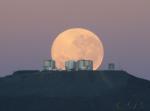 Paranal Moonset
4.11.2006
Just before the rising Sun fully illuminated the 2,635 meter summit of Cerro Paranal in northern Chile, Gordon Gillet captured this stunning moonset. In the telephoto picture, a nearly full October Moon is silhouetting the impressive array of telescopes at ESO's Paranal Observatory.
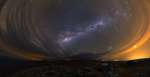 Atacama s Cloudy Night
27.07.2013
Storm clouds do sometimes come to Chile's Atacama desert, known as the driest place on Earth. These washed through the night sky just last month during the winter season, captured in this panoramic view.
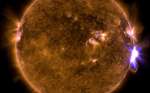 Flare Well AR2673
14.09.2017
Almost out of view from our fair planet, rotating around the Sun's western edge giant active region AR2673 lashed out with another intense solar flare followed by a large coronal mass ejection on September 10.
 Star Factory Messier 17
8.09.2023
Sculpted by stellar winds and radiation, the star factory known as Messier 17 lies some 5,500 light-years away in the nebula-rich constellation Sagittarius. At that distance, this 1/3 degree wide field of view spans over 30 light-years.
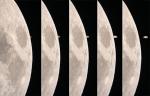 Saturn at the Lunar Limb
22.02.2002
Gliding through the sky on Wednesday evening, February 20th, a first quarter Moon seemed to run over bright planet Saturn as viewed from much of North America. In this sharp sequence of telescopic digital...
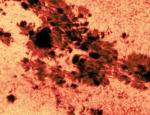 Sunspots: Magnetic Depressions
22.03.1998
Our Sun has spots! These spots appear dark in photographs like the one above, but in fact sunspots are quite bright - they are just dark compared to the rest of the Sun. Sunspots are about the size of the Earth and frequently occur in groups, as shown above.
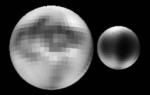 Mysterious Pluto and Charon
8.07.1998
Pluto is the only planet in our Solar System remaining unphotographed by a passing spacecraft. Distant Pluto and its moon Charon therefore remain somewhat mysterious. In addition to direct imaging by the Hubble Space...
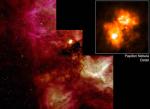 N159 and the Papillon Nebula
14.06.1999
In a search for massive stars, the Hubble Space Telescope has peered into yet another spectacular region of star formation. This nebula, known as N159, spans over 150 light-years and is located in the neighboring Large Magellanic Cloud galaxy, about 170,000 light years distant.
|
January February March April May June July August September October |
|||||||||||||||||||||||||||||||||||||||||||||||||