
|
You entered: Observatory
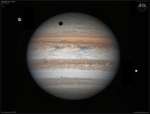 Ganymede s Shadow
24.03.2017
Approaching opposition early next month, Jupiter is offering some of its best telescopic views from planet Earth. On March 17, this impressively sharp image of the solar system's ruling gas giant was taken from a remote observatory in Chile.
 Nearby Spiral M33
1.12.2002
Spiral galaxy M33 is a mid-sized member of our Local Group of Galaxies. M33 is also called the Triangulum Galaxy for the constellation in which it resides. About four times smaller (in radius) than...
 Milky Way Falls
11.01.2019
It can be the driest place on planet Earth, but water still flows in Chile's Atacama desert, high in the mountains. After discovering this small creek with running water, the photographer returned...
 An Atlas Centaur Rocket Launches
13.12.1995
Atlas Centaur rockets have launched over 75 successful unmanned missions. These missions included the Surveyor series - the first vehicles to make soft landings on the Moon, Pioneer 10 and 11 - the first missions...
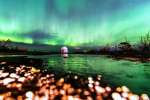 Aurora: The Frog's View
5.10.2018
What does an aurora look like to a frog? "Awesome!" is the likely answer, suggested by this imaginative snapshot taken on October 3rd from Kiruna, Sweden. Frequented by apparitions of the northern lights, Kiruna...
 Hydrogen Trifid
28.08.1998
Clouds of glowing hydrogen gas mingle with dark dust lanes in the Trifid Nebula, a star forming region in the constellation Sagittarius. In this and other similar emission nebulae, energetic ultraviolet light from an embedded hot young star strips electrons from the surrounding hydrogen atoms.
 Spiral Galaxy M90
15.03.1996
Spiral galaxy M90 is near the center of the Virgo Cluster of Galaxies - the closest cluster of galaxies to the our own Milky Way Galaxy. Also dubbed NGC 4569, this galaxy has a very compact and bright nucleus.
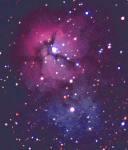 M20: The Trifid Nebula
23.07.1995
The vivid blue and violet colors present in the Trifid Nebula result from the abundance of young stars there. The light from young massive stars is quite blue and has the ability to remove electrons from surrounding gas. When these electrons re-combine with the gas, radiation rich in blue and violet light is emitted.
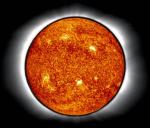 Solar Eclipse: A Composite View
26.02.1998
Yesterday, the Moon's shadow reached out and touched the Earth, treating a large portion of the Western Hemisphere to an Eclipse of the Sun. This composite image combines pictures of the Sun made from both Earth and space.
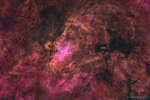 Nest of the Eagle Nebula
3.10.2016
What surrounds the famous Eagle Nebula? The inside of the Eagle Nebula contains eggs -- evaporating gaseous globules -- that typically reside in tremendous pillars of gas and dust and where stars form. This image, though...
|
January February March April May June July August September October |
|||||||||||||||||||||||||||||||||||||||||||||||||