
|
You entered: Observatory
 Ice Fishing for Cosmic Neutrinos
29.04.2001
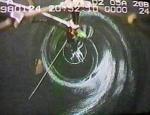
Scientists are melting holes in the bottom of the world. In fact, several holes have been melted near the South Pole, and they are now being used as astronomical observatories. Astronomers with the Antarctic Muon and Neutrino Detector Array (AMANDA) lower into each vertical lake a string knotted with basketball-sized light detectors.
 A Solar Prominence from SOHO
16.04.2006
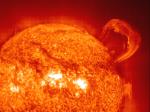
How can gas float above the Sun? Twisted magnetic fields arching from the solar surface can trap ionized gas, suspending it in huge looping structures. These majestic plasma arches are seen as prominences above the solar limb.
 Kemble s Cascade
27.01.2010
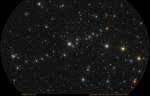
An asterism is just a recognized pattern of stars that is not one the 88 official constellations. For example, one of the most famous (and largest) asterisms is the Big Dipper within the constellation Ursa Major.
 Cerro Tololo Trails
21.10.2016
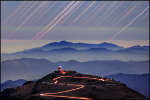
Early one moonlit evening car lights left a wandering trail along the road to the Chilean Cerro Tololo Inter-American Observatory. Setting stars left the wandering trails in the sky. The serene view toward the mountainous horizon was captured in a telephoto timelapse image and video taken from nearby Cerro Pachon, home to Gemini South.
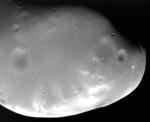 Deimos: A Small Martian Moon
2.09.2001
Mars has two tiny moons, Phobos and Deimos. Pictured above is Deimos, the smaller moon of Mars. In fact, Deimos is one of the smallest known moons in the Solar System measuring only nine miles across.
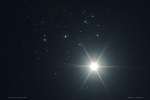 Venus and the Sisters
6.04.2012
After wandering about as far from the Sun on the sky as Venus can get, the brilliant evening star crossed paths with the Pleiades star cluster earlier this week. The beautiful conjunction was enjoyed by skygazers around the world. Taken on April 2, this celestial group photo captures the view from Portal, Arizona, USA.
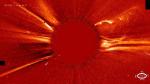 Red Sun Streaming
6.01.1997
The Sun is leaking. In fact, it is gushing: particles stream away from the Sun at hundreds of kilometers per second. Some of these particles strike the Earth and cause aurora. Most particles, however, either surround the Sun as a huge solar corona or glide into interstellar space as the solar wind.
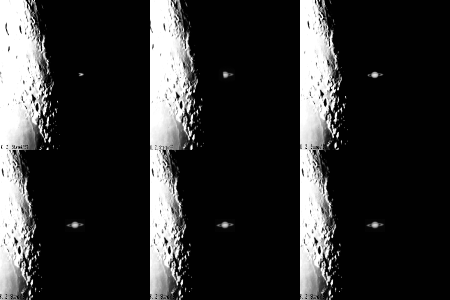 Moon Occults Saturn
8.05.1999
On September 18, 1997, many stargazers in the U. S. were able to watch a lovely early morning lunar occultation as a bright Moon passed in front of Saturn. Using a 1.2 meter reflector, astronomer Kris Stanek had an excellent view of this dream-like event from the Whipple Observatory atop Arizona's Mount Hopkins.
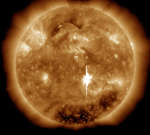 X Class Flare
16.02.2011
On Valentine's Day (ET) the Sun unleased one of its most powerful explosions, an X-class flare. The blast was the largest so far in the new solar cycle. Erupting from active region AR1158...
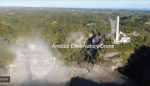 Arecibo Telescope Collapse
8.12.2020
This was one great scientific instrument. Starting in 1963, the 305-meters across Arecibo Telescope in Puerto Rico USA reigned as the largest single-dish radio telescope in the world for over 50 years. Among numerous...
|
January February March April May June July August September October |
|||||||||||||||||||||||||||||||||||||||||||||||||