
|
You entered: Observatory
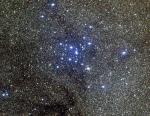 The M7 Open Star Cluster in Scorpius
5.05.2002
M7 is one of the most prominent open clusters of stars on the sky. The cluster, dominated by bright blue stars, can be seen with the naked eye in a dark sky in the tail of the constellation of Scorpius.
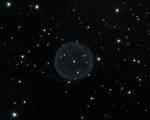 Spherical Planetary Nebula Abell 39
28.07.2005
Ghostly in appearance, Abell 39 is a remarkably simple, spherical nebula about five light-years across. Well within our own Milky Way galaxy, the cosmic sphere is roughly 7,000 light-years distant toward the constellation Hercules.
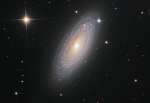 Spiral Galaxy NGC 2841
29.03.2008
Some 50 million light-years distant, spiral galaxy NGC 2841 can be found in the northern constellation of Ursa Major. This sharp view of the gorgeous island universe shows off a striking yellow nucleus and galactic disk with tightly wound spiral arms.
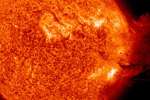 The Sun Unleashed
10.06.2011
On June 7, the Sun unleashed only a medium sized solar flare as rotation carried active regions of sunpots toward the solar limb. But that flare was followed by an astounding gush of magnetized plasma seen erupting at the Sun's edge in this extreme ultraviolet image from the Solar Dynamics Observatory.
 One Night One Telescope One Camera
28.07.2018
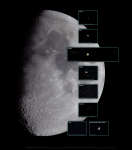
Taken on the same night, from the same place, with the same telescope and camera, these postcards from our Solar System are shown at the same scale to provide an interesting comparison of apparent sizes. Spanning about half a degree in planet Earth's sky, the Moon is a stitched mosaic of six images.
 Billows of Smog in the Outer Galaxy
15.01.2001
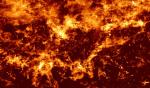
Our Galaxy is filled with gas. Most of this gas is hydrogen, some is helium, but there is a trace amount of relatively heavy molecules, including carbon monoxide (CO) - a component of smog. The above wide-angle radio CO image shows the incredibly diverse structures that the molecular interstellar medium forms.
 Ultraviolet Earth from the Moon
1.07.2000
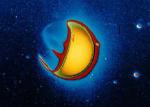
Here's a switch: the above picture is of the Earth taken from a lunar observatory! This false color picture shows how the Earth glows in ultraviolet (UV) light. UV light is so blue humans can't see it.
 Painting with Solar Neutrons
25.10.1995
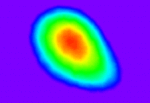
Solar flares are propelled high above the Sun's surface by powerful, twisted magnetic fields. The flares spew high energy atomic and subatomic particles into space. During an intense solar flare on June 15, 1991, a spray of solar neutrons was detected by the COMPTEL instrument onboard NASA's Compton Gamma Ray Observatory.
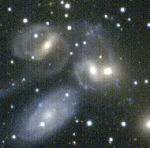 A Quintet of Galaxies
15.11.1995
Five closely grouped galaxies are visible in this image made using the Kitt Peak National Observatory 2.1 meter telescope. The grouping is commonly known as Stephan's Quintet. Four of the galaxies show essentially the same redshift suggesting that they are at the same distance from us.
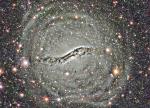 The Outer Shells of Centaurus A
11.11.2002
What causes the surrounding shells in peculiar galaxy Cen A? Last month a fascinating image of peculiar galaxy Centaurus A was released, processed to highlight a faint blue arc indicating an ongoing collision with a smaller galaxy.
|
January February March April May June July August September October |
|||||||||||||||||||||||||||||||||||||||||||||||||