
|
You entered: Observatory
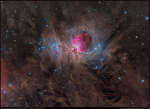 The Great Orion Nebula M42
4.11.2015
The Great Nebula in Orion, also known as M42, is one of the most famous nebulas in the sky. The star forming region's glowing gas clouds and hot young stars are on the right in this sharp and colorful image that includes the bluish reflection nebulae NGC 1977 and friends on the left.
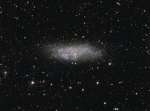 Wolf Lundmark Melotte
19.05.2017
Named for the three astronomers instrumental in its discovery and identification, Wolf - Lundmark - Melotte (WLM) is a lonely dwarf galaxy. Seen toward the mostly southern constellation Cetus, about 3 million light-years from the Milky Way, it is one of the most remote members of our local galaxy group.
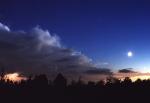 Clearing Skies
26.07.2002
Clear evening skies are a welcome sight for stargazers worldwide, but clearing skies are good too. Just such a glorious occasion was recorded in this dramatic photo taken by Dominic Cantin during a recent gathering of Canadian astronomers at St-NИrИe Observatory, located about 60 kilometers southeast of the city of Quebec.
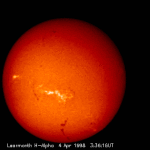 The Sun Changes
13.04.1998
Our Sun changes every day. This recent picture was taken in a very specific red color called Hydrogen-Alpha. Dark spots that might appear on the image are usually sunspots, dark magnetic depressions that are slightly cooler than the rest of the Sun's surface.
 Bright Comet SOHO
21.05.1998
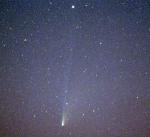
Discovered this month with an orbiting solar observatory, bright Comet SOHO has now emerged from the Sun's glare. This telephoto picture of the new naked-eye comet was taken by astrophotographer Michael Horn after sunset in the western twilight above Lake Samsonvale, Brisbane, Australia on May 18. The comet is seen in the constellation Orion.
 Mangaia's Milky Way
24.09.2011
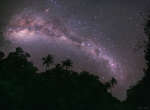
From Sagittarius to Carina, the Milky Way Galaxy shines in this dark night sky above planet Earth's lush island paradise of Mangaia. Familiar to denizens of the southern hemisphere, the gorgeous skyscape includes the bulging galactic center at the upper left and bright stars Alpha and Beta Centauri just right of center.
 Wolf-Lundmark-Melotte
7.04.2016
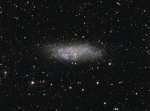
Named for the three astronomers instrumental in its discovery and identification, Wolf - Lundmark - Melotte (WLM) is a lonely dwarf galaxy. Seen toward the mostly southern constellation Cetus, about 3 million light-years from the Milky Way, it is one of the most remote members of our local galaxy group.
 Mid Eclipse and Milky Way
27.05.2021
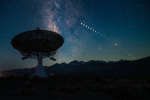
May's perigee Full Moon slid through Earth's shadow yesterday entertaining night skygazers in regions around the Pacific. Seen from western North America, it sinks toward the rugged Sierra Nevada mountain range in this time-lapse series of the total lunar eclipse.
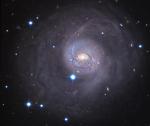 The Outskirts of M77
7.12.2006
Face-on spiral galaxy M77 lies a mere 60 million light-years away toward the constellation Cetus. Also known as NGC 1068, it's very bright core is well studied by astronomers exploring the mysteries of supermassive black holes in active galaxies.
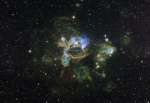 The N44 Complex
27.03.2008
A truly giant complex of emission nebulae, N44 is about 1,000 light-years across. It shines in southern skies as a denizen of our neighboring galaxy, the Large Magellanic Cloud, 170,000 light-years away.
|
January February March April May June July August September October |
|||||||||||||||||||||||||||||||||||||||||||||||||