
|
You entered: Observatory
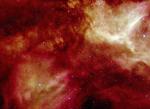 N159 and the Papillon Nebula
21.12.2003
In a search for massive stars, the Hubble Space Telescope has peered into yet another spectacular region of star formation. This nebula, known as N159, spans over 150 light-years and is located in the neighboring Large Magellanic Cloud galaxy, about 170,000 light years distant.
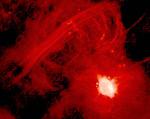 The Galactic Center Radio Arc
3.04.2005
What causes this unusual structure near the center of our Galaxy? The long parallel rays slanting across the top of the above radio image are known collectively as the Galactic Center Radio Arc and jut straight out from the Galactic plane.
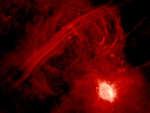 The Galactic Center Radio Arc
27.04.2008
What causes this unusual structure near the center of our Galaxy? The long parallel rays slanting across the top of the above radio image are known collectively as the Galactic Center Radio Arc and jut straight out from the Galactic plane.
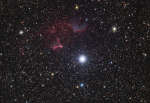 Gamma Cas and Friends
24.12.2009
Gamma Cassiopeiae shines high in northern autumn evening skies. The brightest spiky star in this rich and colorful Milky Way starfield, bluish Gamma Cas marks the central peak in the W-shaped constellation Cassiopeia.
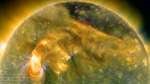 The Not So Quiet Sun
6.08.2010
After a long solar minimum, the Sun is no longer so quiet. On August 1, this extreme ultraviolet snapshot of the Sun from the Solar Dynanimcs Observatory captured a complex burst of activity playing across the Sun's northern hemisphere.
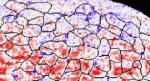 The Solar Wind Emerges
8.02.1999
Winds of fast particles blow out from the Sun, but why? Astronomers came a step closer to answering this question recently by making detailed observations of the high-speed wind source with the space-borne Solar and Heliospheric Observatory (SOHO).
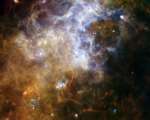 Herschel Views the Milky Way
2.09.2011
With a 3.5 meter diameter mirror, larger than the Hubble Space Telescope, ESA's Herschel Space Observatory explores the Universe at infrared wavelengths. Herschel is named for German-born British astronomer Frederick William Herschel who discovered infrared light over 200 years ago.
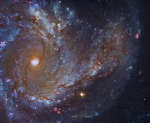 Messier 61 Close Up
28.08.2019
Image data from the Hubble Space Telescope, the European Southern Observatory, and small telescopes on planet Earth are combined in this magnificent portrait of face-on spiral galaxy Messier 61 (M61). A mere 55 million light-years away in the Virgo Cluster of Galaxies, M61 is also known as NGC 4303.
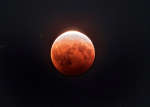 Total Lunar Eclipse from Sydney
28.05.2021
The reddened shadow of planet Earth plays across the lunar disk in this telescopic image taken on May 26 near Sydney, New South Wales, Australia. On that crisp, clear autumn night a Perigee Full Moon slid through the northern edge of the shadow's dark central umbra.
 Abell 3627 in the Great Attractor
18.02.1996
Are these galaxies near the center of the largest gravitationally bound concentration of mass yet known? Previously, the cluster of galaxies known as Abell 3627 was largely unstudied because dust in the disk of our own Galaxy obscured much of its light.
|
January February March April May June July August September October |
|||||||||||||||||||||||||||||||||||||||||||||||||