
|
You entered: Observatory
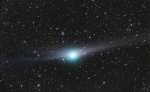 Another Tail for Comet Garradd
3.03.2012
Remarkable comet Garradd (C2009/P1) has come to be known for two distinctive tails. From the perspective of earthbound comet watchers the tails are visible on opposite sides of its greenish coma. Seen here in a telescopic view, the recognizable dust tail fans out to the right, trailing the comet nucleus in its orbit.
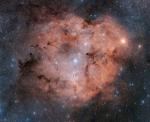 IC 1396 in Cepheus
8.09.2005
Stunning emission nebula IC 1396 mixes glowing cosmic gas and dark dust clouds in the high and far off constellation of Cepheus. As pictured here, the star forming region sprawls across hundreds of light-years -- spanning over three degrees on the sky while nearly 3,000 light-years from planet Earth.
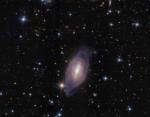 Polar Ring Galaxy NGC 2685
16.02.2007
NGC 2685 is a confirmed polar ring galaxy - a rare type of galaxy with stars, gas and dust orbiting in rings perpendicular to the plane of a flat galactic disk. The bizarre configuration could...
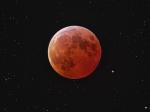 Eclipsed Moon and Stars
8.03.2007
This dramatic image features a dark red Moon during a total lunar eclipse -- celestial shadow play enjoyed by many denizens of planet Earth last Saturday. Recorded near Wildon, Austria, the picture is a composite...
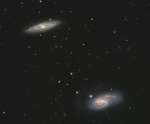 M65 and M66
15.06.2012
Nearby and bright, spiral galaxies M65 (top) and M66 stand out in this engaging cosmic snapshot. The pair are just 35 million light-years distant and around 100,000 light-years across, about the size of our own spiral Milky Way.
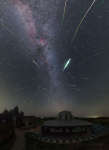 Perseid Meteors over Slovakia
12.08.2019
Tonight is a good night to see meteors. Comet dust will rain down on planet Earth, streaking through dark skies during the peak of the annual Perseid Meteor Shower. The featured composite image was taken during last year's Perseids from the Poloniny Dark Sky Park in Slovakia.
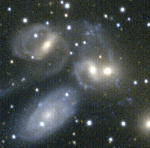 Disorder in Stephan's Quintet
13.12.1996
Five closely grouped galaxies are visible in this image made using the Kitt Peak National Observatory 2.1 meter telescope. The grouping is commonly known as Stephan's Quintet. Four of the galaxies show essentially the same redshift suggesting that they are at the same distance from us.
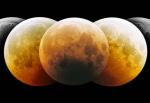 Eclipsed Moon Montage
22.05.2003
After watching this month's lunar eclipse, amateur astronomer Sebastien Gauthier carefully composed this montage of telescopic images of the Moon sliding through planet Earth's shadow. While the deepest part of the total...
 Perihelion Sun
11.01.1999
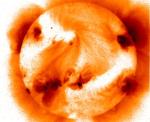
The Earth's orbit is not a perfect, sun-centered circle. At aphelion, the most distant point in Earth's orbit, the Sun is 150 million kilometers away and at perihelion, the closest point, Earth approaches the Sun to within about 147 million kilometers. While aphelion occurs in July, perihelion for planet Earth comes in January.
 The Iron Sun
25.09.2004
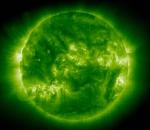
The ultraviolet light emitted by eleven times ionized iron at temperatures over 2 million degrees Farenheit was used to record the above picture of the Sun on September 22, 2001, the date of that year's autumnal equinox.
|
January February March April May June July August September October |
|||||||||||||||||||||||||||||||||||||||||||||||||