
|
You entered: Observatory
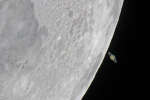 The Moons Saturn
7.04.2013
Just days after sharing the western evening sky with Venus in 2007, the Moon moved on to Saturn - actually passing in front of the ringed planet Saturn when viewed in skies over Europe, northern Africa, and western Asia.
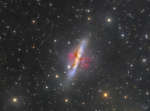 M82: Starburst Galaxy with a Superwind
8.07.2021
M82 is a starburst galaxy with a superwind. In fact, through ensuing supernova explosions and powerful winds from massive stars, the burst of star formation in M82 is driving a prodigious outflow. Evidence for the superwind from the galaxy's central regions is clear in sharp telescopic snapshot.
 APOD: 2025 January 1 Б Alpha Centauri: The Closest Star System
31.12.2024
The closest star system to the Sun is the Alpha Centauri system. Of the three stars in the system, the dimmest -- called Proxima Centauri -- is actually the nearest star. The bright stars Alpha Centauri...
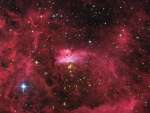 Massive Stars in NGC 6357
9.10.2008
Massive Stars lie within NGC 6357, an expansive emission nebula complex some 8,000 light-years away in the tail of the constellation Scorpius. In fact, positioned just below center in this close-up view...
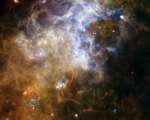 Herschel Views the Milky Way
16.10.2009
With a 3.5 meter diameter mirror, larger than the Hubble Space Telescope, Herschel is ESA's new infrared observatory. The space-based telescope is named for German-born British astronomer Frederick William Herschel who discovered infrared light over 200 years ago.
 SDO: The Extreme Ultraviolet Sun
23.04.2010
Don't panic, the Sun has not gone wild. But this wild-looking portrait of the nearest star to planet Earth was made on March 30th by the recently launched Solar Dynamics Observatory (SDO). Shown in false-color, the composite view covers extreme ultraviolet wavelengths and traces hot plasma at temperatures approaching 1 million kelvins.
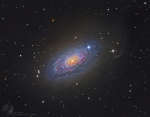 Messier 63: The Sunflower Galaxy
13.03.2014
A bright spiral galaxy of the northern sky, Messier 63 is about 25 million light-years distant in the loyal constellation Canes Venatici. Also cataloged as NGC 5055, the majestic island universe is nearly 100,000 light-years across. That's about the size of our own Milky Way Galaxy.
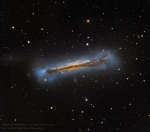 NGC 3682: Sideways Spiral Galaxy
4.09.2018
What do spiral galaxies look like sideways? Featured is a sharp telescopic view of a magnificent edge-on spiral galaxy NGC 3628, a puffy galactic disk divided by dark dust lanes. Of course, this deep galactic portrait puts some astronomers in mind of its popular moniker, The Hamburger Galaxy.
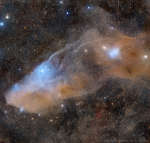 IC 4592: The Blue Horsehead Reflection Nebula
4.07.2021
Do you see the horse's head? What you are seeing is not the famous Horsehead nebula toward Orion but rather a fainter nebula that only takes on a familiar form with deeper imaging. The main part of the here imaged molecular cloud complex is a reflection nebula cataloged as IC 4592.
 APOD: 2024 November 25 Б The Horsehead Nebula
24.11.2024
One of the most identifiable nebulas in the sky, the Horsehead Nebula in Orion, is part of a large, dark, molecular cloud. Also known as Barnard 33, the unusual shape was first discovered on a photographic plate in the late 1800s.
|
January February March April May June July August September October |
|||||||||||||||||||||||||||||||||||||||||||||||||