
|
You entered: Observatory
 2001 Leonids: Meteors in Perspective
6.11.2002
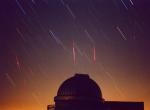
The 2001 Leonid storm was so intense that the meteor shower's radiant, the point on the sky from which the fleeting trails seemed to diverge, was easy to spot. But the bits of debris that created the meteors really moved along parallel paths, following the orbit of their parent comet Tempel-Tuttle.
 Ice Fishing for Cosmic Neutrinos
3.08.2003
Scientists are melting holes in the bottom of the world. In fact, several holes have been melted near the South Pole, and they are now being used as astronomical observatories. Astronomers with the Antarctic Muon and Neutrino Detector Array (AMANDA) lower into each vertical lake a string knotted with basketball-sized light detectors.
 Interacting Galaxies
10.07.1998
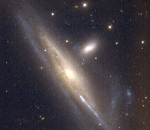
This dramatic image of an interacting pair of galaxies was made using the 1.5 meter telescope at the Cerro Tololo Inter-American Observatory near La Serena, Chile. NGC 1531 is the background galaxy with a bright core just above center and NGC 1532 is the foreground spiral galaxy laced with dust lanes.
 Earth at Night
8.07.2017
Can you find your favorite country or city? Surprisingly, on this world-wide nightscape, city lights make this task quite possible. Human-made lights highlight particularly developed or populated areas of the Earth's surface, including the seaboards of Europe, the eastern United States, and Japan.
 Hawaii
27.04.2002
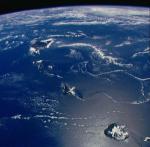
Aloha! With the graceful arc of Earth's limb in the background, the Hawaiian Island archipelago is visible in this stunning photo taken by the astronauts onboard the shuttle Discovery in October of 1988. Along with popular beaches and tropical resorts, these volcanic islands offer extreme elevations with dark, dry, cloudless skies.
 The Fox Fur Nebula
1.07.2002
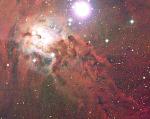
The nebula surrounding bright star S Mon is filled with dark dust and glowing gas. The strange shapes that surrounding this star originate from fine interstellar dust reacting in complex ways with the energetic light and hot gas being expelled by the young stars.
 Hawaii
15.12.1995
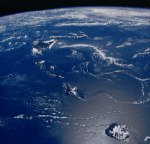
Aloha! With the graceful arc of the Earth's limb in the background, the entire Hawaiian Island archipelago is visible in this stunning photo taken by the astronauts onboard the shuttle Discovery in October of 1988. Along with popular beaches and tropical resorts, these volcanic islands offer extreme elevations with dark, dry, cloudless skies.
 NGC 4314: A Nuclear Starburst Ring
15.06.1998
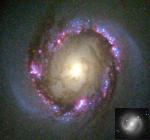
Is this old galaxy up to new tricks? The barred spiral galaxy NGC 4314 is billions of years old, but its appearance has changed markedly over just the past few millions of years. During that time, a nuclear ring of bright young stars has been evolving.
 M65 Without Moth
7.08.1998
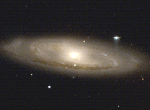
Messier 65 (M65) is a bright spiral galaxy of stars only 35 million light-years away in the constellation Leo. With very tightly wound spiral arms, a large central bulge, and well defined dust lanes, this galaxy is a member of a group of galaxies known as the Leo triplet.
 A Great Day For SOHO
15.10.1998
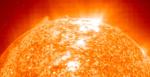
The last 10 days have been great days for SOHO, the space-based SOlar and Heliospheric Observatory. Contact was completely lost with this international research spacecraft over 3 months ago but recovery teams have reacquired control of SOHO and, beginning October 5th, have been successfully switching on its scientific instruments.
|
January February March April May June July August September October |
|||||||||||||||||||||||||||||||||||||||||||||||||