
|
You entered: Observatory
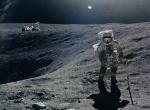 Apollo 16: Exploring Plum Crater
19.03.2000
Apollo 16 spent three days on Earth's Moon in April 1972. The fifth lunar landing mission out of six, Apollo 16 was famous for deploying and using an ultraviolet telescope as the first lunar observatory, and for collecting rocks and data on the mysterious lunar highlands. In the above picture, astronaut John W.
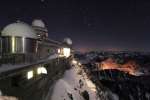 Winter Night at Pic du Midi
25.01.2008
This dreamlike view looking south from the historic mountain top Pic du Midi Observatory combines moonlit domes, a winter night sky, and the snowy peaks of the French Pyrenees. Encroaching on the night, lights...
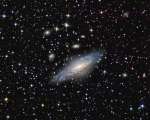 NGC 7331 and Beyond
12.07.2008
Big, beautiful spiral galaxy NGC 7331 is often touted as an analog to our own Milky Way. About 50 million light-years distant in the northern constellation Pegasus, NGC 7331 was recognized early on as a spiral nebula and is actually one of the brighter galaxies not included in Charles Messier's famous 18th century catalog.
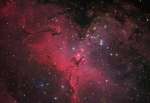 M16 and the Eagle Nebula
19.07.2008
Young star cluster M16 is surrounded by natal clouds of cosmic dust and glowing gas also known as The Eagle Nebula. This beautifully detailed image of the region includes fantastic shapes made famous in well-known Hubble Space Telescope close-ups of the starforming complex.
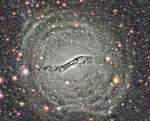 The Outer Shells of Centaurus A
1.07.2012
What causes the surrounding shells in peculiar galaxy Cen A? In 2002 a fascinating image of peculiar galaxy Centaurus A was released, processed to highlight a faint blue arc indicating an ongoing collision with a smaller galaxy.
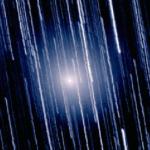 Tempel-Tuttle: The Leonid Comet
30.01.1998
Star trails streak this composite time exposure of Comet Tempel-Tuttle recorded by T. Puckett on January 26. Presently passing through the inner solar system on its 33 year orbit around the Sun, Tempel-Tuttle has brightened unexpectedly, but binoculars or small telescopes are still required to visually observe it.
 Beta Pictoris Revisited
28.11.1997
In the early 1980s, Beta Pictoris became one of the most important stars in the sky. Satellite and ground-based telescopic observations revealed the presence of a surrounding outer disk of material and an inner "clear" zone about the size of our solar system - strong evidence for the formation of planets.
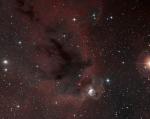 LDN 1622: Dark Nebula in Orion
11.05.2007
The silhouette of an intriguing dark nebula inhabits this cosmic scene, based on images from the Palomar Observatory Sky Survey. Lynds' Dark Nebula (LDN) 1622 appears against a faint background of glowing hydrogen gas only easily seen in long telescopic exposures of the region.
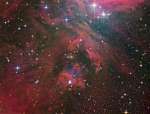 South of Orion
3.04.2008
This tantalizing array of nebulae and stars can be found about 2 degrees south of the famous star-forming Orion Nebula. The region abounds with energetic young stars producing jets and outflows that push through the surrounding material at speeds of hundreds of kilometers per second.
 Lyrids in Southern Skies
24.04.2014
Earth's annual Lyrid meteor shower peaked before dawn on April 22nd, as our fair planet plowed through dust from the tail of long-period comet Thatcher. Even in the dry and dark Atacama desert along Chile's Pacific coast, light from a last quarter Moon made the night sky bright, washing out fainter meteor streaks.
|
January February March April May June July August September October |
|||||||||||||||||||||||||||||||||||||||||||||||||