
|
You entered: Observatory
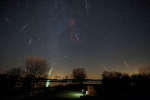 Leonids and Friends
20.11.2015
Leonid meteors rained down on planet Earth this week, the annual shower of dusty debris from the orbit of Comet 55P/Tempel-Tuttle. Leonids streak through this composite night skyview from a backyard observatory in southern Ontario.
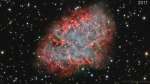 M1: The Incredible Expanding Crab
4.01.2018
The Crab Nebula is cataloged as M1, the first on Charles Messier's famous list of things which are not comets. In fact, the Crab is now known to be a supernova remnant, an expanding cloud of debris from the explosion of a massive star.
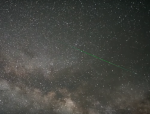 Night of the Perseids
28.09.2021
Have you ever experienced a meteor shower? To help capture the wonder, a video was taken during the peak of the recent Perseid meteor shower above the Indian Astronomical Observatory in Hanle, India, high up in the Himalayan mountains.
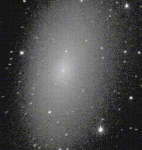 Local Group Galaxy NGC 205
8.01.1996
The Milky Way Galaxy is not alone. It is part of a gathering of about 25 galaxies known as the Local Group. Members include the Great Andromeda Galaxy (M31), M32, M33, the Large Magellanic Clouds, the Small Magellanic Clouds, Dwingeloo 1, several small irregular galaxies, and many dwarf elliptical galaxies.
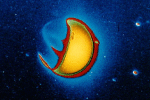 Ultraviolet Earth
10.06.1996
Here's a switch: the above picture is of the Earth taken from a lunar observatory! This false color picture shows how the Earth glows in ultraviolet (UV) light. UV light is so blue humans can't see it.
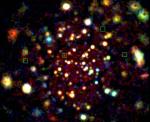 X-Ray Pleiades
18.03.1997
The Pleiades star cluster is one of the jewels of the northern sky. To the unaided eye it appears as a lovely and tantalizing grouping of stars in the constellation of Taurus, while telescopic views reveal cluster stars surrounded by delicate blue wisps of dust-reflected starlight.
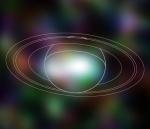 X Ray Saturn
12.03.2004
Above, the ringed planet Saturn shines in x-rays. Otherwise beyond the range of human vision, the eerie x-ray view was created by overlaying a computer generated outline of the gas giant's disk and ring system on a false-color picture of smoothed, reconstructed x-ray data from the orbiting Chandra Observatory.
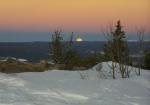 Shadow Set
27.01.2005
A nearly full Moon and planet Earth's shadow set together in this scene captured Monday from snowy Mt. Jelm, home of the Wyoming Infrared Observatory. For early morning risers (and late...
 VERITAS and Venus
8.11.2007
Early morning risers and late to bed astronomers have recently enjoyed bright planets in predawn skies, with brilliant Venus above the eastern horizon. On November 5, Venus was joined by the waning crescent Moon.
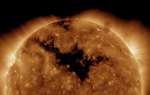 Hole in the Sun
28.08.2010
This ominous, dark shape sprawling across the face of the Sun is a coronal hole -- a low density region extending above the surface where the solar magnetic field opens freely into interplanetary space. Studied...
|
January February March April May June July August September October |
|||||||||||||||||||||||||||||||||||||||||||||||||