
|
You entered: Observatory
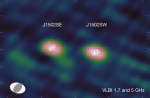 J1502 1115: A Triple Black Hole Galaxy
7.07.2014
Most galaxies contain one supermassive black hole -- why does this galaxy have three? The likely reason is that galaxy J1502+1115 is the product of the recent coalescence of three smaller galaxies.
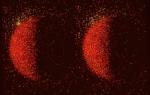 X Ray Moon and X Ray Star
9.09.2000
An x-ray star winks out behind the Moon in these before (left) and after views of a lunar occultation of the galactic x-ray source designated GX5-1. The false color images were made using data from the ROSAT (ROentgen SATellite), orbiting observatory.
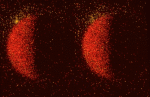 X-ray Moon and X-ray Star
27.02.1996
An X-ray star winks out behind the Moon in these before and after views of a lunar occultation of the galactic X-ray source designated GX5-1. The false color images were made using data...
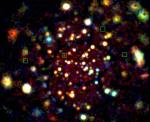 X-Ray Pleiades
5.04.1998
The Pleiades star cluster is one of the jewels of the northern sky. To the unaided eye it appears as a lovely and tantalizing grouping of stars in the constellation of Taurus, while telescopic views reveal cluster stars surrounded by delicate blue wisps of dust-reflected starlight.
 Tentacles of the Tarantula Nebula
28.12.2004
The Tarantula Nebula is a giant emission nebula within our neighboring galaxy the Large Magellanic Cloud. Inside this cosmic arachnid lies a huge central young cluster of massive stars, cataloged as R136 and partially visible on the upper right.
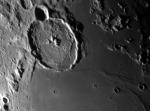 Lunar Close Up
12.02.1999
Late last month, NASA's Lunar Prospector spacecraft moved in for a closer look at the Moon. Now entering an extended mission phase, controllers have reduced the altitude of this polar lunar orbiter from 100 kilometers to about 30 kilometers (18 miles).
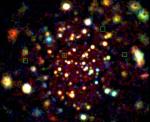 X-Ray Pleiades
28.08.1999
The Pleiades star cluster is one of the jewels of the northern sky. To the unaided eye it appears as an alluring group of stars in the constellation Taurus, while telescopic views reveal cluster stars surrounded by delicate blue wisps of dust-reflected starlight.
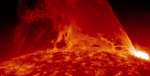 A Solar Prominence Eruption from SDO
26.05.2019
One of the most spectacular solar sights is an erupting prominence. In 2011, NASA's Sun-orbiting Solar Dynamic Observatory spacecraft imaged an impressively large prominence erupting from the surface. The dramatic explosion was captured in ultraviolet light in the featured time lapse video covering 90 minutes, where a new frame was taken every 24 seconds.
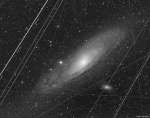 Andromeda before Photoshop
14.10.2019
What does the Andromeda galaxy really look like? The featured image shows how our Milky Way Galaxy's closest major galactic neighbor really appears in a long exposure through Earth's busy skies and with a digital camera that introduces normal imperfections.
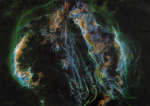 Supernova Remnant: The Veil Nebula
22.06.2022
Ten thousand years ago, before the dawn of recorded human history, a new light would have suddenly have appeared in the night sky and faded after a few weeks. Today we know this light was from a supernova, or exploding star, and record the expanding debris cloud as the Veil Nebula, a supernova remnant.
|
January February March April May June July August September October |
|||||||||||||||||||||||||||||||||||||||||||||||||