
|
You entered: Observatory
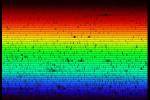 The Solar Spectrum
15.08.2000
It is still not known why the Sun's light is missing some colors. Shown above are all the visible colors of the Sun, produced by passing the Sun's light through a prism-like device.
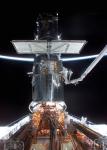 SM3B: Mission to Hubble
14.03.2002
Now complete, Servicing Mission 3B (SM3B) was really the fourth trip to the Hubble Space Telescope, as the originally planned mission 3 was split into two parts. Falling around planet Earth, about 320 nautical...
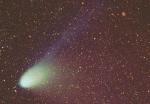 Comet Hale-Bopp and the Dumbbell Nebula
20.02.1997
Comet Hale-Bopp is now slowly moving across the morning sky. During its trip to our inner Solar System, the comet passes in front of several notable objects. Here Comet Hale-Bopp was photographed on February 11th superposed nearly in front of the picturesque Dumbbell Nebula, visible on the upper right.
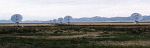 A Very Large Array of Radio Telescopes
27.07.1997
Pictured above is one of the world's premiere radio astronomical observatories: The Very Large Array (VLA). Each antenna dish is as big as a house (25 meters across) and mounted on railroad tracks. The VLA consists of 27 dishes - together capable of spanning the size of a city (35 kilometers).
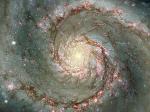 M51: The Whirlpool Galaxy in Dust and Stars
5.09.2004
The Whirlpool Galaxy is a classic spiral galaxy. At only 30 million light years distant and fully 60 thousand light years across, M51, also known as NGC 5194, is one of the brightest and most picturesque galaxies on the sky.
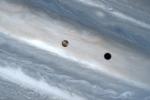 Io Shadow
23.04.1999
Orbiting Jupiter once every 43 hours, the volcanic moon Io cruises 500,000 kilometers above swirling, banded cloud-tops. Orbiting Earth once every 1.5 hours, the Hubble Space Telescope watched as Io accompanied by its shadow crossed the face of the reigning gas giant planet in 1997.
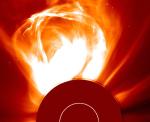 Sun Storm: A Coronal Mass Ejection
9.03.2000
Late last month another erupting filament lifted off the active solar surface and blasted this enormous bubble of magnetic plasma into space. Direct light from the sun is blocked in this picture of the event with the sun's relative position and size indicated by a white half circle at bottom center.
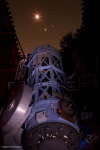 The 60 inch Reflector
13.12.2008
On the night of December 13, 1908, 100 years ago today, the 60-inch diameter reflecting telescope of Mount Wilson Observatory was first tested on the stars. It became the first successful large reflecting telescope.
 A Solar Prominence Eruption from SDO
6.03.2016
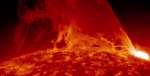
One of the most spectacular solar sights is an erupting prominence. In 2011, NASA's Sun-orbiting Solar Dynamic Observatory spacecraft imaged an impressively large prominence erupting from the surface. The dramatic explosion was captured in ultraviolet light in the above time lapse video covering 90 minutes, where a new frame was taken every 24 seconds.
 Cooling Neutron Star
1.05.2017
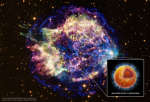
The bright source near the center is a neutron star, the incredibly dense, collapsed remains of a massive stellar core. Surrounding it is supernova remnant Cassiopeia A (Cas A), a comfortable 11,000 light-years away. Light from the Cas A supernova, the death explosion of a massive star, first reached Earth about 350 years ago.
|
January February March April May June July August September October |
|||||||||||||||||||||||||||||||||||||||||||||||||