
|
You entered: Observatory
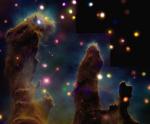 APOD: 2007 February 24- X rays and the Eagle Nebula
24.02.2007
The premier Chandra X-ray Observatory images of M16, the Eagle Nebula, show many bright x-ray sources in the region. Most of the x-ray sources are energetic young stars. They are seen here as colored spots superimposed on the Hubble's well-known optical view of M16's light-year long Pillars of Creation.
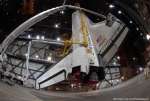 Atlantis Lift Off
8.05.2010
Atlantis has lifted off, but not from launch pad 39A. Instead, this sharp, wide-angle photo taken on April 13, shows the space shuttle orbiter lifted off the floor of Kennedy Space Center's Vehicle Assembly Building. Shortly afterwards, Atlantis was attached to an external fuel tank and solid rocket boosters prior to roll out.
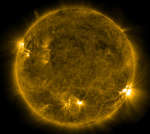 Equinox and the Iron Sun
23.09.2010
Today, the Sun crosses the celestial equator heading south at 03:09 Universal Time. Known as an equinox, this astronomical event marks the first day of autumn in the northern hemisphere and spring in the south. Equinox means equal night.
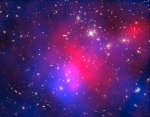 Abell 2744: Pandoras Cluster of Galaxies
29.06.2011
Why is this cluster of galaxies so jumbled? Far from a smooth distribution, Abell 2744 not only has knots of galaxies, but the X-ray emitting hot gas (colored red) in the cluster appears distributed differently than the dark matter.
 Galaxies in the River
8.01.2020
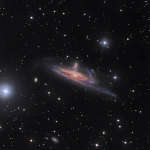
Large galaxies grow by eating small ones. Even our own galaxy engages in a sort of galactic cannibalism, absorbing small galaxies that are too close and are captured by the Milky Way's gravity.
 APOD: 2025 September 27 Б A Rocket in the Sun
27.09.2025
On the morning of September 24 a rocket crosses the bright solar disk in this long range telescopic snapshot captured from Orlando, Florida. That's about 50 miles north of its Kennedy Space Center launch site. This rocket carried three new space weather missions to space.
 A Very Large Array of Radio Telescopes
21.06.1996
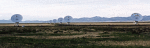
Pictured above is one of the world's premiere radio astronomical observatories: The Very Large Array (VLA). Each antenna dish is as big as a house (25 meters across) and mounted on railroad tracks. The VLA consists of 27 dishes - together capable of spanning the size of a city (35 kilometers).
 The Swarm
28.01.2005
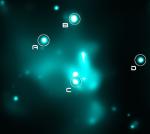
What do you call a group of black holes ... a flock, a brace, a swarm? Monitoring a region around the center of our Galaxy, astronomers have indeed found evidence for a surprisingly large number...
 Tentacles of the Tarantula Nebula
22.08.2007
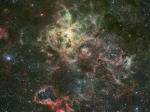
The largest, most violent star forming region known in the whole Local Group of galaxies lays in our neighboring galaxy the Large Magellanic Cloud (LMC). Were the Tarantula Nebula at the distance of the Orion Nebula -- a local star forming region -- it would take up fully half the sky.
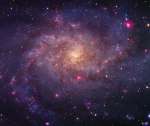 Bright Nebulae in M33
17.10.2009
Gorgeous spiral galaxy M33 seems to have more than its fair share of bright emission nebulae. In fact, narrow-band and broad-band image data are combined in this beautifully detailed composite to trace the reddish emission nebulae, star forming HII regions, sprawling along loose spiral arms that wind toward the galaxy's core.
|
January February March April May June July August September October |
|||||||||||||||||||||||||||||||||||||||||||||||||