
|
You entered: Observatory
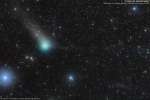 Comet PanSTARRS in the Southern Fish
17.06.2016
Now approaching our fair planet this Comet PanSTARRS (C/2013 X1) will come closest on June 21-22, a mere 5.3 light-minutes away. By then its appearance low in northern hemisphere predawn skies (high in the south), will be affected by the light of a nearly Full Moon, though.
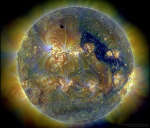 Venus and the Triply Ultraviolet Sun
6.03.2022
This was a very unusual type of solar eclipse. Typically, it is the Earth's Moon that eclipses the Sun. In 2012, though, the planet Venus took a turn. Like a solar eclipse by the Moon, the phase of Venus became a continually thinner crescent as Venus became increasingly better aligned with the Sun.
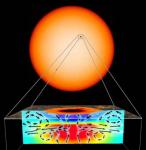 Under A Sunspot
8.11.2001
At the Sun's surface, sunspots are known to be dark, planet-sized regions of intense magnetic fields. But what lies below? Using observations from the Michelson Doppler Imager (MDI) instrument aboard the space-based SOHO observatory, astronomers have derived this premier picture of the flow of material just beneath a visible sunspot.
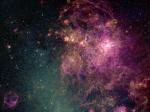 30 Doradus: The Tarantula Zone
12.12.2005
The Tarantula Nebula is more than 1,000 light-years across - a giant emission nebula within our neighboring galaxy the Large Magellanic Cloud. Inside this cosmic arachnid lies a central young cluster of massivestars, cataloged as R136, whose intense radiation and strong winds have helped energize the nebular glow and shape the spidery filaments.
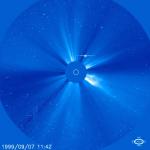 A Superior Conjunction Of Mercury
8.09.1999
In astronomical parlance, an interior planet is at superior conjunction when it is located on the opposite side of the Sun from Earth. Mercury, the solar system's innermost planet, zips past this point in its orbit today.
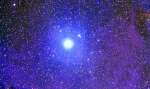 Polaris Dust Nebula
11.01.2008
Centered on North Star Polaris, this 4 degree wide field of view covers part of a complex of relatively unfamiliar, diffuse dust clouds soaring high above the plane of our Milky Way Galaxy.
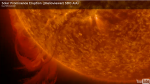 A Huge Solar Filament Erupts
15.12.2010
Click the arrow and watch an unusually long filament explode out from the Sun. The filament had been seen hovering over the Sun's surface for over a week before it erupted earlier this month.
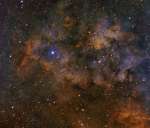 Sharpless 115
14.06.2013
Sharpless 115 stands just north and west of Deneb, the alpha star of Cygnus the Swan in planet Earth's skies. Noted in the 1959 catalog by astronomer Stewart Sharpless (as Sh2-115) the faint...
 Sun Dance
10.10.2018
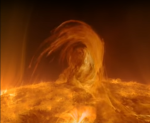
Sometimes, the surface of our Sun seems to dance. In the middle of 2012, for example, NASA's Sun-orbiting Solar Dynamic Observatory spacecraft imaged an impressive prominence that seemed to perform a running dive roll like an acrobatic dancer.
 NGC 281: Starless with Stars
19.11.2021
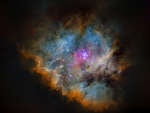
In visible light the stars have been removed from this narrow-band image of NGC 281, a star forming region some 10,000 light-years away toward the constellation Cassiopeia. Stars were digitally added back to the resulting starless image though.
|
January February March April May June July August September October |
|||||||||||||||||||||||||||||||||||||||||||||||||