
|
You entered: Observatory
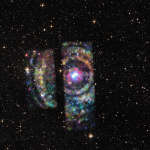 X ray Echoes from Circinus X 1
5.08.2015
Circinus X-1 is an X-ray binary star known for its erratic variability. In the bizarre Circinus X-1 system, a dense neutron star, the collapsed remnant of a supernova explosion, orbits with a more ordinary stellar companion.
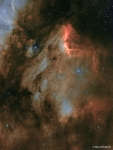 IC 5070: A Dusty Pelican in the Swan
19.11.2016
The recognizable profile of the Pelican Nebula soars nearly 2,000 light-years away in the high flying constellation Cygnus, the Swan. Also known as IC 5070, this interstellar cloud of gas and dust...
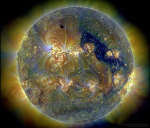 Venus and the Triply Ultraviolet Sun
4.02.2018
An unusual type of solar eclipse occurred in 2012. Usually it is the Earth's Moon that eclipses the Sun. That year, most unusually, the planet Venus took a turn. Like a solar eclipse by the Moon, the phase of Venus became a continually thinner crescent as Venus became increasingly better aligned with the Sun.
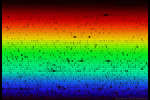 The Suns Spectrum with its Missing Colors
26.09.2018
It is still not known why the Sun's light is missing some colors. Here are all the visible colors of the Sun, produced by passing the Sun's light through a prism-like device.
 North of Orion s Belt
5.11.2020
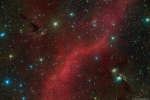
Bright stars, interstellar clouds of dust and glowing nebulae fill this cosmic scene, a skyscape just north of Orion's belt. Close to the plane of our Milky Way Galaxy, the wide field view spans just under 5 degrees or about 10 full moons on the sky.
 APOD: 2023 December 11 Б Solar Minimum versus Solar Maximum
11.12.2023
The surface of our Sun is constantly changing. Some years it is quiet, showing relatively few sunspots and active regions. Other years it is churning, showing many sunspots and throwing frequent Coronal Mass Ejections (CMEs) and flares.
 The Crab Nebula Pulsar Shrugs
20.09.2002
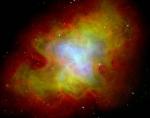
How does a city-sized neutron star power the vast Crab Nebula? The expulsion of wisps of hot gas at high speeds appears to be at least part of the answer. Yesterday time-lapse movies taken...
 72.6: Oxygen Supply
28.05.2003
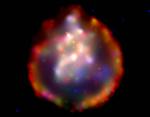
A supernova explosion, a massive star's inevitable and spectacular demise, blasts back into space debris enriched in the heavy elements forged in its stellar core. Incorporated into future stars and planets, these are the elements ultimately necessary for life.
 Pelican Nebula Ionization Front
13.10.2003
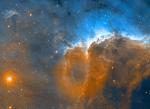
What's happening to the Pelican Nebula? The light from young energetic stars is slowly transforming the Pelican's cold gas to hot gas, with the advancing boundary between the two known as an ionization front.
 X Ray Triple Jet
16.07.1998
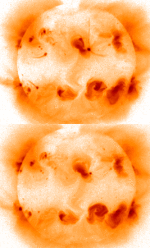
Recorded on July 7, this animation using X-ray images of the Sun shows an amazing event - three nearly simultaneous jets connected with solar active regions. The two frames were taken several hours apart by the Soft X-ray Telescope on board the orbiting Yohkoh observatory.
|
January February March April May June July August September October |
|||||||||||||||||||||||||||||||||||||||||||||||||