
|
You entered: Observatory
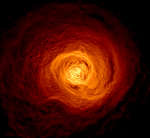 The Perseus Cluster Waves
4.05.2017
The cosmic swirl and slosh of giant waves in an enormous reservoir of glowing hot gas are traced in this enhanced X-ray image from the Chandra Observatory. The frame spans over 1 million light-years across the center of the nearby Perseus Galaxy Cluster, some 240 million light-years distant.
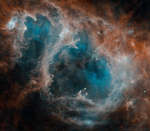 The Soul Nebula in Infrared from Herschel
4.10.2017
Stars are forming in the Soul of the Queen of Aethopia. More specifically, a large star forming region called the Soul Nebula can be found in the direction of the constellation Cassiopeia, who Greek mythology credits as the vain wife of a King who long ago ruled lands surrounding the upper Nile river.
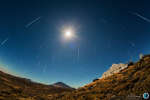 Full Moon Geminids
13.12.2019
The dependable annual Geminid meteor shower will be near its peak tonight (December 13/14) and before tomorrow's dawn. As Earth crosses through the dusty trail of active asteroid 3200 Phaethon the meteors will flash through the sky from the shower's radiant in Gemini.
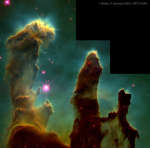 M16: Pillars of Star Creation
6.12.2020
These dark pillars may look destructive, but they are creating stars. This pillar-capturing image of the inside of the Eagle Nebula, taken with the Hubble Space Telescope in 1995, shows evaporating gaseous globules (EGGs) emerging from pillars of molecular hydrogen gas and dust.
 Odysseus and The Dish
1.03.2024
Murriyang, the CSIROБs Parkes radio telescope points toward a nearly Full Moon in this image from New South Wales, Australia, planet Earth. Bathed in moonlight, the 64 meter dish is receiving weak radio signals from Odysseus, following the robotic lander's February 22 touch down some 300 kilometers north of the Moon's south pole.
 Cas A Supernova Remnant in X Rays
24.08.2002
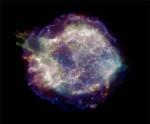
The complex shell of a star seen to explode 300 years ago is helping astronomers to understand how that star exploded. This Chandra Observatory image of supernova remnant Cassiopeia A (Cas A) shows unprecedented detail in three x-ray colors.
 Spiral Galaxy In Centaurus
27.01.2000
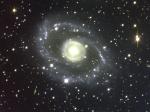
Centaurus, the Centaur, is one of the most striking constellations in the southern sky. The lovely Milky Way flows through this large constellation whose celestial wonders also include the closest star to the sun, Alpha Centauri, the largest globular star cluster in our galaxy, Omega Centauri, and the closest active galaxy, Centaurus A.
 A Pelican in the Swan
30.11.2006
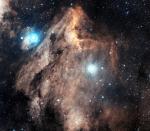
The Pelican Nebula lies about 2,000 light-years away in the high flying constellation Cygnus, the Swan. Also known as IC 5070, this cosmic pelican is appropriately found just off the "east coast" of the North America Nebula (NGC 7000), another surprisingly familiar looking emission nebula in Cygnus.
 Moondog Night
10.12.2014
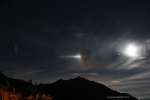
In this night scene from the early hours of November 14, light from a last quarter Moon illuminates clouds above the mountaintop domes of Kitt Peak National Observatory near Tucson, Arizona. Bright Jupiter...
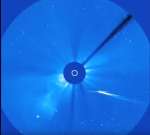 Comet ISON Being Destroyed by the Sun
2.11.2015
Most comets don't survive a close encounter with the Sun. Two years ago this month, though, Comet ISON was thought by some to be big enough to withstand its perilous sungrazing dive. The featured video shows the drama as it was recorded by NASA's Solar and Heliospheric Observatory (SOHO) satellite.
|
January February March April May June July August September October |
|||||||||||||||||||||||||||||||||||||||||||||||||