
|
You entered: Observatory
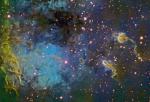 The Tadpoles of IC 410
11.01.2006
This close-up view shows a portion of otherwise faint emission nebula IC 410 in striking false-colors. It also shows two remarkable denizens of the glowing gas cloud at the right - the "tadpoles" of IC 410. The picture is a composite of images taken through narrow band filters intended to trace atoms in the nebula.
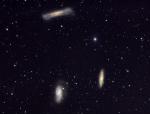 Trio Leo
9.03.2006
This popular group is famous as the Leo Triplet - a gathering of three magnificent galaxies in one field of view. Crowd pleasers when imaged with even modest telescopes, these galaxies can be introduced individually as NGC 3628 (top), M66 (bottom left), and M65 (bottom right). All three are large spiral galaxies.
 100 Hours of Astronomy Begins
2.04.2009
Today, 100 Hours of Astronomy begins, a cornerstone project of the International Year of Astronomy 2009 celebrating the 400th anniversary of Gallileo's original telescopic exploration of the sky. Running from April 2 through...
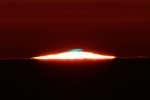 A Green Flash from the Sun
4.01.2011
Many think it is just a myth. Others think it is true but its cause isn't known. Adventurers pride themselves on having seen it. It's a green flash from the Sun. The truth is the green flash does exist and its cause is well understood.
 APOD: 2024 October 6 Б The Magnificent Tail of Comet McNaught
6.10.2024
Comet McNaught, the Great Comet of 2007, grew a spectacularly long and filamentary tail. The magnificent tail spread across the sky and was visible for several days to Southern Hemisphere observers just after sunset. The amazing ion tail showed its greatest extent on long-duration, wide-angle camera exposures.
 APOD: 2025 January 8 Б Supernova Remnants Big and Small
8.01.2025
What happens after a star explodes? A huge fireball of hot gas shoots out in all directions. When this gas slams into the existing interstellar medium, it heats up so much it glows. Two different supernova remnants (SNRs) are visible in the featured image, taken at the Oukaцmeden Observatory in Morocco.
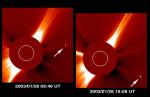 Comet Kudo-Fujikawa: Days in the Sun
30.01.2003
Cruising through the inner Solar System, new Comet Kudo-Fujikawa reached perihelion, its closest approach to the Sun, yesterday, January 29. Passing within 28.4 million kilometers of the Sun, this comet came much closer than innermost planet Mercury basking only 57.9 million kilometers from our parent star.
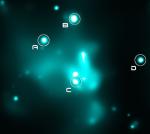 The Swarm
29.07.2006
What do you call a group of black holes ... a flock, a brace, a swarm? Monitoring a region around the center of our Galaxy, astronomers have indeed found evidence for a surprisingly large number...
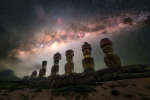 APOD: 2026 March 25 Б The Guardians of Rapa Nui beneath the Milky Way
25.03.2026
In the words of today's astrophotographer, Rositsa Dimitrova, "What have these silent sentinels watched pass across the sky?" The volcanic mo'ai (meaning statue) of Ahu Tongariki stand guard over Rapa Nui (Isla...
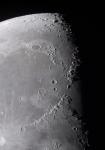 Moon Mare and Montes
28.12.2000
This arresting image of the third quarter moon in the excellent skies above the Pine Crest Farm Observatory, Dell Prairie, Wisconsin, was recorded with a 24 inch telescope and digital camera on October 19.
|
January February March April May June July August September October |
|||||||||||||||||||||||||||||||||||||||||||||||||