
|
You entered: Observatory
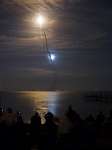 Endeavour in the Moon
20.11.2008
Glaring near the top of the frame, the shuttle orbiter Endeavour rockets into the night on the STS-126 mission. Endeavour left planet Earth on November 14 from Launch Pad 39A at NASA's Kennedy Space Center, making the 27th flight to the International Space Station.
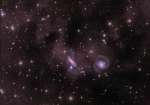 Dust and the NGC 7771 Group
21.01.2010
Galaxies of the NGC 7771 Group are featured in this intriguing skyscape. Some 200 million light-years distant toward the constellation Pegasus, NGC 7771 is the large, edge-on spiral near center, about 75,000 light-years across, with two smaller galaxies just below it. Large spiral NGC 7769 is seen face-on to the right.
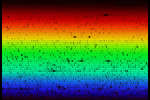 All the Colors of the Sun
28.06.2015
It is still not known why the Sun's light is missing some colors. Here are all the visible colors of the Sun, produced by passing the Sun's light through a prism-like device.
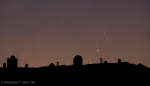 Full Venus and Crescent Moon Rise
14.04.2016
Inner planet Venus and a thin crescent Moon are never found far from the Sun in planet Earth's skies. Taken near dawn on April 6, this timelapse composite shows them both rising just before the Sun. The mountaintop Teide Observatory domes on the fortunate island of Tenerife appear in silhouette against the twilight.
 APOD: 2024 August 18 Б A Solar Prominence Eruption from SDO
18.08.2024
One of the most spectacular solar sights is an erupting prominence. In 2011, NASA's Sun-orbiting Solar Dynamic Observatory spacecraft imaged an impressively large prominence erupting from the surface. The dramatic explosion was captured in ultraviolet light in the featured time lapse video covering 90 minutes, where a new frame was taken every 24 seconds.
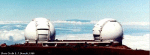 Keck: The Largest Optical Telescope
15.07.1996
In buildings eight stories tall rest mirrors ten meters across that are slowly allowing humanity to map the universe. Alone, each is the world's largest optical telescope: Keck. Together, the twin Keck telescopes have the resolving power of a single telescope 90-meter in diameter, able to discern sources just milliarcseconds apart.
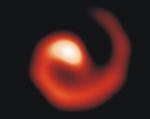 WR 104: Pinwheel Star
9.04.1999
Like a cosmic lawn sprinkler, dust streaming from a rotating star system creates a pinwheel pattern in this false color infrared image. Astronomers discovered the surprising star dust scenario using a sophisticated interferometer and the 10 meter Keck I telescope to observe the bright Wolf-Rayet star WR 104.
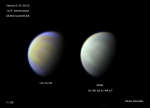 Multicolor Venus
1.03.2012
Brilliant Venus now shines in western skies at twilight. Seen as the prominent evening star, the planet is a tantalizing celestial beacon even for casual skygazers. Venus can offer less than satisfying telescopic views though. The planet is shrouded in reflective clouds that appear bright but featureless at the eyepiece.
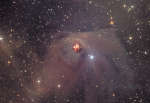 T Tauri and Hind s Variable Nebula
3.05.2014
The yellowish star near center in this dusty telescopic skyview is T Tauri, prototype of the class of T Tauri variable stars. Just next door is the yellow cosmic cloud historically known as Hind's Variable Nebula (NGC 1555).
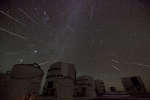 When Gemini Sends Stars to Paranal
13.12.2015
From a radiant point in the constellation of the Twins, the annual Geminid meteor shower rain down on planet Earth. Tonight, the Geminds reach their peak and could be quite spectacular. The featured blended image, however, captured the shower's impressive peak in the year 2012.
|
January February March April May June July August September October |
|||||||||||||||||||||||||||||||||||||||||||||||||