
|
You entered: Observatory
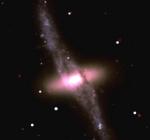 NGC 4650A: Strange Galaxy and Dark Matter
25.06.1998
This strangely distorted galaxy of stars is cataloged as NGC 4650A. It lies about 165 million light-years away in the southern constellation Centaurus. The complex system seems to have at least two parts, a flattened disk of stars with a dense, bright, central core and a sparse, sharply tilted ring of gas, dust and stars.
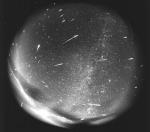 Leonids from Leo
16.11.2003
Is Leo leaking? Leo, the famous sky constellation visible on the left of the above all-sky photograph, appears to be the source of all the meteors seen in 1998's Leonids Meteor Shower. That...
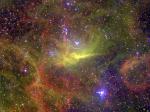 Nebulas Surrounding Wolf Rayet Binary
BAT99 49
Nebulas Surrounding Wolf Rayet Binary
BAT99 49
21.04.2004
How could two young stars power these colorful interstellar gas clouds? Although hidden by thick dust, the stars spew forceful ions and energetic radiation that cause the clouds to fragment and light up.
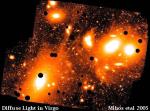 Streams of Stars in the Virgo Cluster of Galaxies
26.09.2005
How do huge clusters of galaxies evolve? To help find out, astronomers pointed the wide-angle Burrell-Schmidt telescope on Kitt Peak National Observatory in Arizona, USA at the nearby Virgo Cluster of Galaxies. After hundreds...
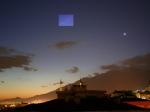 Venus and Comet Pojmanski
3.03.2006
Shining brightly in the east at dawn, Venus dominates the sky in this view over a suburban landscape from Bursa, Turkey. An otherwise familiar scene for astronomer Tunc Tezel, his composite picture of the morning sky recorded on March 2nd also includes a surprise visitor to the inner solar system, Comet Pojmanski.
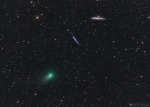 The Comet, the Whale, and the Hockey Stick
13.05.2021
Closest to the Sun on March 1, and closest to planet Earth on April 23, this Comet ATLAS (C/2020 R4) shows a faint greenish coma and short tail in this pretty, telescopic field of view.
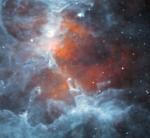 Cold Dust in the Eagle Nebula
14.09.2001
Stars are born in M16's Eagle Nebula, a stellar nursery 7,000 light-years from Earth toward the constellation Serpens. The striking nebula's star forming pillars of gas and dust are familiar to astronomers from images at visible wavelengths, but this false-color picture shows off the nebula in infrared light.
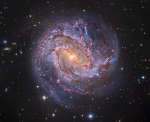 M83: The Thousand Ruby Galaxy
8.10.2015
Big, bright, and beautiful, spiral galaxy M83 lies a mere twelve million light-years away, near the southeastern tip of the very long constellation Hydra. Prominent spiral arms traced by dark dust lanes and blue star clusters lend this galaxy its popular name, The Southern Pinwheel.
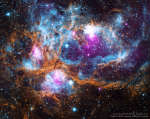 NGC 6357: Stellar Wonderland
26.12.2016
For reasons unknown, NGC 6357 is forming some of the most massive stars ever discovered. This complex wonderland of star formation consists of numerous filaments of dust and gas surrounding huge cavities of massive star clusters. The intricate patterns are caused by complex interactions between interstellar winds, radiation pressures, magnetic fields, and gravity.
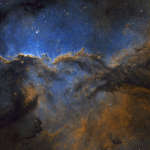 NGC 6188: The Dragons of Ara
7.11.2018
Dark shapes with bright edges winging their way through dusty NGC 6188 are tens of light-years long. The emission nebula is found near the edge of an otherwise dark large molecular cloud in the southern constellation Ara, about 4,000 light-years away.
|
January February March April May June July August September October |
|||||||||||||||||||||||||||||||||||||||||||||||||