
|
You entered: Observatory
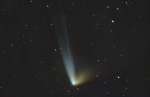 Comet Tails and Star Trails
21.07.2015
After grazing the western horizon on northern summer evenings Comet PanSTARRS (also known as C/2014 Q1) climbed higher in southern winter skies. A visitor to the inner Solar System discovered in August 2014 by the prolific panSTARRS survey, the comet was captured here on July 17.
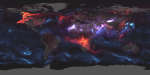 Aerosol Earth
1.09.2018
On August 23, 2018 the identification and distribution of aerosols in the Earth's atmosphere is shown in this dramatic, planet-wide visualization. Produced in real time, the Goddard Earth Observing System Forward Processing (GEOS...
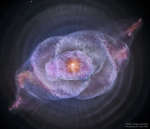 The Cats Eye Nebula in Optical and Xray
1.05.2019
To some it looks like a cat's eye. To others, perhaps like a giant cosmic conch shell. It is actually one of brightest and most highly detailed planetary nebula known, composed of gas expelled in the brief yet glorious phase near the end of life of a Sun-like star.
 Northern Pluto
18.08.2023
Gaze across the frozen canyons of northern Pluto in this contrast enhanced color scene. The image data used to construct it was acquired in July 2015 by the New Horizons spacecraft as it made the first reconnaissance flight through the remote Pluto system six billion kilometers from the Sun.
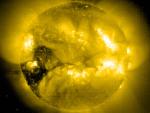 Coronal Holes on the Sun
18.03.2003
The ominous, dark shapes haunting the left side of the Sun are coronal holes -- low density regions extending above the surface where the solar magnetic field opens freely into interplanetary space. Studied extensively from...
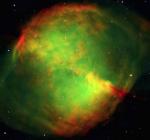 M27: Not A Comet
9.10.1998
While searching the skies above 18th century France for comets, astronomer Charles Messier diligently recorded this object as number 27 on his list of things which are definitely not comets. So what is it?
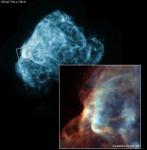 Supernova Remnant and Shock Wave
17.02.2006
A massive star ends life as a supernova, blasting its outer layers back to interstellar space. The spectacular death explosion is initiated by the collapse of what has become an impossibly dense stellar core. Pictured is the expanding supernova remnant Puppis A - one of the brightest sources in the x-ray sky.
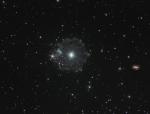 Cat s Eye Wide and Deep
29.06.2007
The Cat's Eye Nebula (NGC 6543) is one of the best known planetary nebulae in the sky. Its more familiar outlines are seen in the the brighter central region of this impressive wide-angle view. But the composite image also combines many short and long exposures to reveal the nebula's extremely faint halo.
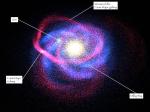 The Closest Galaxy: Canis Major Dwarf
4.11.2007
What is the closest galaxy to the Milky Way? The new answer to this old question is the Canis Major dwarf galaxy. For many years astronomers thought the Large Magellan Cloud (LMC) was closest, but its title was supplanted in 1994 by the Sagittarius dwarf galaxy.
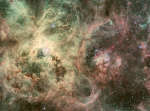 Tentacles of the Tarantula Nebula
18.05.2010
The largest, most violent star forming region known in the whole Local Group of galaxies lies in our neighboring galaxy the Large Magellanic Cloud (LMC). Were the Tarantula Nebula at the distance of the Orion Nebula -- a local star forming region -- it would take up fully half the sky.
|
January February March April May June July August September October |
|||||||||||||||||||||||||||||||||||||||||||||||||