
|
You entered: Observatory
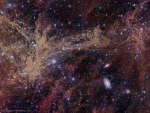 The M81 Galaxy Group through the Integrated Flux Nebula
27.06.2017
Distant galaxies and nearby nebulas highlight this deep image of the M81 Group of galaxies. First and foremost in this 80-exposure mosaic is the grand design spiral galaxy M81, the largest galaxy in the image, visible on the lower right.
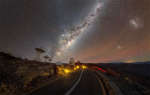 A Road to the Stars
15.03.2022
Pictured -- a very scenic road to the stars. The road approaches La Silla Observatory in Chile, with the ESO's 3.6-meter telescope just up ahead. To the left are some futuristic-looking support structures...
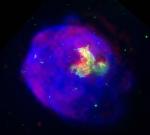 Structure in N63A
1.01.2004
Shells and arcs abound in this false-color, multiwavelength view of supernova remnant N63A, the debris of a massive stellar explosion. The x-ray emission (blue), is from gas heated to 10 million degrees C as knots of fast moving material from the cosmic blast sweep up surrounding interstellar matter.
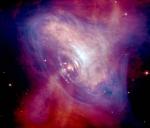 Composite Crab
26.03.2005
(xxxre linkxxx) The Crab Pulsar, a city-sized, magnetized neutron star spinning 30 times a second, lies at the center of this composite image of the inner region of the well-known Crab Nebula. The spectacular...
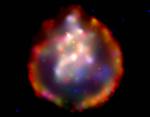 SNR 0103 72.6: Oxygen Supply
13.08.2005
A supernova explosion, a massive star's inevitable and spectacular demise, blasts back into space debris enriched in the heavy elements forged in its stellar core. Incorporated into future stars and planets, these are the elements ultimately necessary for life. Seen here in a false-color x-ray image, supernova remnant SNR 0103-72
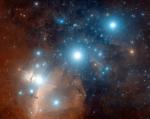 Alnitak, Alnilam, Mintaka
13.10.2005
Alnitak, Alnilam, and Mintaka, are the bright bluish stars from east to west (left to right) along the diagonal in this gorgeous cosmic vista. Otherwise known as the Belt of Orion, these three blue supergiant stars are hotter and much more massive than the Sun.
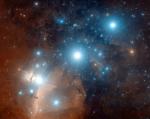 Alnitak, Alnilam, Mintaka
29.12.2006
Alnitak, Alnilam, and Mintaka, are the bright bluish stars from east to west (left to right) along the diagonal in this gorgeous cosmic vista. Otherwise known as the Belt of Orion, these three blue supergiant stars are hotter and much more massive than the Sun.
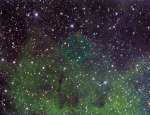 A Bubble in Cygnus
13.11.2008
Adrift in the rich star fields of the constellation Cygnus, this lovely, symmetric bubble nebula was only recently recognized and may not yet appear in astronomical catalogs. In fact, amateur astronomer Dave Jurasevich identified...
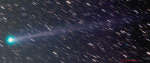 Comet McNaught Becoming Visible to the Unaided Eye
7.06.2010
A new comet is brightening and is now expected to become visible to the unaided eye later this month. C/2009 R1 (McNaught) is already showing an impressive tail and is currently visible through binoculars.
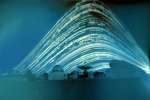 Days in the Sun
21.01.2012
From solstice to solstice, this six month long exposure compresses time from the 21st of June till the 21st of December, 2011, into a single point of view. Dubbed a solargraph, the unconventional picture was recorded with a pinhole camera made from a drink can lined with a piece of photographic paper.
|
January February March April May June July August September October |
|||||||||||||||||||||||||||||||||||||||||||||||||