
|
You entered: Observatory
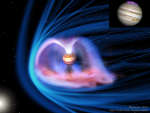 Auroras and the Magnetosphere of Jupiter
6.04.2016
Jupiter has auroras. Like near the Earth, the magnetic field of our Solar System's largest planet compresses when impacted by a gust of charged particles from the Sun. This magnetic compression funnels charged particles towards Jupiter's poles and down into the atmosphere.
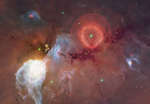 Massive Shell Expelling Star G79 29 0 46
25.09.2017
Stars this volatile are quite rare. Captured in the midst of dust clouds and visible to the right and above center is massive G79.29+0.46, one of less than 100 luminous blue variable stars (LBVs) currently known in our Galaxy.
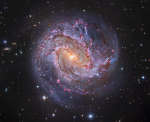 M83: The Thousand Ruby Galaxy
29.06.2019
Big, bright, and beautiful, spiral galaxy M83 lies a mere twelve million light-years away, near the southeastern tip of the very long constellation Hydra. Prominent spiral arms traced by dark dust lanes and blue star clusters lend this galaxy its popular name, The Southern Pinwheel.
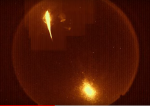 Meteor Fireballs in Light and Sound
15.03.2021
Yes, but have you ever heard a meteor? Usually, meteors are too far away to make any audible sound. However, a meteor will briefly create an ionization trail that can reflect a distant radio signal. If the geometry is right, you may momentarily hear -- through your radio -- a distant radio station even over static.
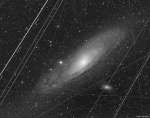 APOD: 2026 September 27 Б Andromeda before Photoshop
27.09.2026
What does the Andromeda galaxy really look like? The featured image shows how our Milky Way Galaxy's closest major galactic neighbor really appears in a long exposure through Earth's busy skies and with a digital camera that introduces normal imperfections.
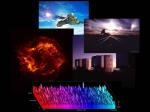 A Year of New Perspectives
28.12.1999
Fittingly, 1999 saw a decade of astronomical discoveries to an end with portents of things to come - embodied in new spacecraft, telescopes, and perspectives to explore the distant Universe across the electromagnetic spectrum. X-ray astronomy in particular will likely flourish in coming
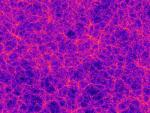 The Universe in Hot Gas
20.08.2002
Where is most of the normal matter in the Universe? Recent observations from the Chandra X-ray Observatory confirm that it is in hot gas filaments strewn throughout the universe. "Normal matter" refers to known elements and familiar fundamental particles.
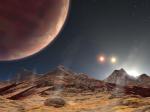 HD 188753: Triple Sunset
5.08.2005
Although it looks like fiction, this artist's vision of sunset on an alien world is based on fact -- the recent discovery of a hot, jupiter-sized planet orbiting in triple star system HD 188753.
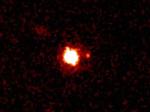 Eris: The Largest Known Dwarf Planet
18.09.2006
Is Pluto the largest dwarf planet? No! Currently, the largest known dwarf planet is (136199) Eris, renamed last week from 2003 UB313. Eris is just slightly larger than Pluto, but orbits as far as twice Pluto's distance from the Sun.
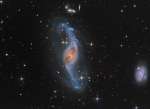 Twisting with NGC 3718
3.08.2013
A careful look at this colorful cosmic snapshot reveals a surprising number of galaxies both near and far toward the constellation Ursa Major. The most striking is NGC 3718, the warped spiral galaxy near picture center. NGC 3718's spiral arms look twisted and extended, mottled with young blue star clusters.
|
January February March April May June July August September October |
|||||||||||||||||||||||||||||||||||||||||||||||||