
|
You entered: Observatory
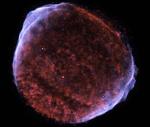 SN 1006: Supernova Remnant in X Rays
25.12.2005
This huge puff ball was once a star. One thousand years ago, in the year 1006, a new star was recorded in the sky that today we know was really an existing star exploding.
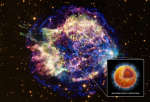 Cooling Neutron Star
4.03.2011
Supernova remnant Cassiopeia A (Cass A) is a comfortable 11,000 light-years away. Light from the Cass A supernova, the death explosion of a massive star, first reached Earth just 330 years ago.
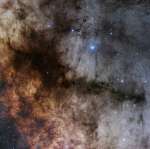 The Pipe Nebula
23.11.2012
East of Antares, dark markings sprawl through crowded star fields toward the center of our Milky Way Galaxy. Cataloged in the early 20th century by astronomer E. E. Barnard, the obscuring interstellar dust clouds include B59, B72, B77 and B78, seen in silhouette against the starry background.
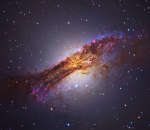 Centaurus A
18.11.2015
What's the closest active galaxy to planet Earth? That would be Centaurus A, only 11 million light-years distant. Spanning over 60,000 light-years, the peculiar elliptical galaxy is also known as NGC 5128.
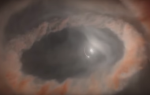 GW Orionis: A Star System with Titled Rings
28.09.2020
Triple star system GW Orionis appears to demonstrate that planets can form and orbit in multiple planes. In contrast, all the planets and moons in our Solar System orbit in nearly the same plane. The picturesque system has three prominent stars, a warped disk, and inner tilted rings of gas and grit.
 APOD: 2024 July 28 Б Sun Dance
27.07.2024
Sometimes, the surface of our Sun seems to dance. In the middle of 2012, for example, NASA's Sun-orbiting Solar Dynamic Observatory spacecraft imaged an impressive prominence that seemed to perform a running dive roll like an acrobatic dancer.
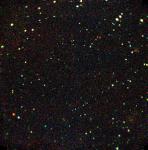 Chandra Deep Field
28.03.2001
Officially the Chandra Deep Field - South, this picture represents the deepest ever x-ray image of the Universe. One million seconds of accumulated exposure time with the orbiting Chandra X-ray Observatory went in to its making.
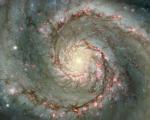 M51: The Whirlpool Galaxy in Dust and Stars
10.04.2001
The Whirlpool Galaxy is a classic spiral galaxy. At only 30 million light years distant and fully 60 thousand light years across, M51, also known as NGC 5194, is one of the brightest and most picturesque galaxies on the sky.
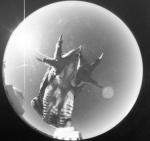 A New Constellation Takes Hold
1.04.2003
A new constellation has taken hold of the sky, much to the surprise of many sky gazers. The constellation of Ollie the Owl has suddenly started dominating the southern hemisphere, as shown above. The constellation is taking the place of Wrinkles the Rhinoceros, who was unexpectedly voted off they sky by the other constellations.
 M82: Starburst in X-rays
21.04.2000
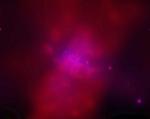
Star formation occurs at a faster pace in M82 -- a galaxy with about 10 times the rate of massive star birth (and death) compared to our Milky Way. Winds from massive stars and blasts...
|
January February March April May June July August September October |
|||||||||||||||||||||||||||||||||||||||||||||||||