
|
You entered: Observatory
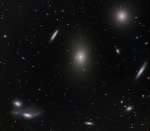 M86 in the Virgo Cluster
25.04.2008
Bright lenticular galaxy M86 is near center of this cosmic view, at the heart of the Virgo Galaxy Cluster. Other bright galaxies in the neighborhood include M84 at the upper right, edge-on spiral NGC4388...
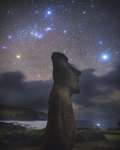 Orion above Easter Island
18.09.2017
Why were the statues on Easter Island built? No one is sure. What is sure is that over 800 large stone statues exist there. The Easter Island statues, stand, on the average, over twice as tall as a person and have over 200 times as much mass.
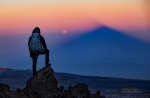 Moonrise and Mountain Shadow
14.03.2020
What phase of the Moon is 3.14 radians from the Sun? The Full Moon, of course. Even though the Moon might look full for several days, the Moon is truly at its full phase when it is 3.14 radians (aka 180 degrees) from the Sun in ecliptic longitude.
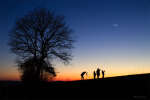 APOD: 2023 March 15 Б Jupiter and Venus Converge over Germany
15.03.2023
This was a sky to show the kids. Early this month the two brightest planets in the night sky, Jupiter and Venus, appeared to converge. At their closest, the two planets were separated by only about the angular width of the full moon.
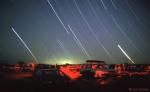 Star Party Trails
21.05.1999
Stargazing is fun! If you'd like to try it, this weekend may be your chance as many astronomy clubs and organizations will be hosting public celebrations of Astronomy Day on Saturday, May 22nd. In recent years, open house nights at observatories, astronomy club gatherings, and star parties have become increasingly popular.
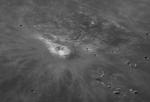 Aristarchus Plateau
30.11.2007
Anchored in the vast lava flows of the Moon's Oceanus Procellarum lies the Aristarchus Plateau. The bright impact crater at the corner of the plateau is Aristarchus, a young crater 42 kilometers wide and 3 kilometers deep. Only slightly smaller, lava flooded Herodotus crater is above and to the left.
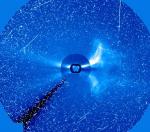 SOHO Composite: Coronal Mass Ejection
20.08.1998
This complex composite image of an ominous and spectacular event - an expanding storm of energetic particles from the Sun - was constructed using data recorded by the SOHO spacecraft on November 6, 1997. Four images...
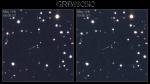 GRB 990510: Another Unusual Gamma Ray Burst
26.05.1999
Another huge explosion has lit up the universe, and astronomers are studying it as best they can before the light fades away. Two weeks ago, the BATSE instrument on the orbiting NASA Great Observatory Compton detected unusually bright flashes of gamma-rays from a point deep in the southern sky.
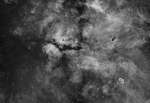 Central Cygnus Skyscape
27.10.2009
In cosmic brush strokes of glowing hydrogen gas, this beautiful skyscape unfolds across the plane of our Milky Way Galaxy and the center of the northern constellation Cygnus the Swan. Recorded from a premier remote observatory site (ROSA) in southern France, the image spans about 6 degrees.
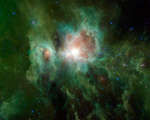 Infrared Orion from WISE
13.02.2013
The Great Nebula in Orion is a intriguing place. Visible to the unaided eye, it appears as a small fuzzy patch in the constellation of Orion. But this image, an illusory-color composite of four...
|
January February March April May June July August September October |
|||||||||||||||||||||||||||||||||||||||||||||||||