
|
You entered: Observatory
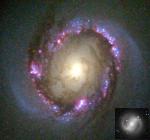 NGC 4314: A Nuclear Starburst Ring
12.12.1999
Is this old galaxy up to new tricks? The barred spiral galaxy NGC 4314 is billions of years old, but its appearance has changed markedly over just the past few millions of years. During that time, a nuclear ring of bright young stars has been evolving.
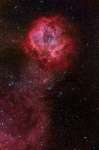 Long Stem Rosette
14.02.2008
The Rosette Nebula (aka NGC 2237) is not the only cosmic cloud of gas and dust to evoke the imagery of flowers. But it is the one most often suggested as a suitable astronomy image for Valentine's Day.
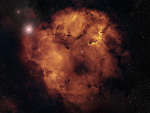 Monsters of IC 1396
25.04.2011
Is there a monster in IC 1396? Known to some as the Elephant's Trunk Nebula, parts of the glowing gas and dust clouds of this star formation region may appear to take on foreboding forms, some nearly human. The entire nebula might even look like a face of a monster.
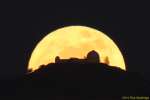 Apogee Full Moon
18.01.2014
This big, bright, beautiful Full Moon rose over Lick Observatory Wednesday night. Traditionally a full moon in January might be called the Wolf Moon. But this moon reached its full phase on January 16, 4:54 UT, within about 2 hours of apogee, the most distant point in its elliptical orbit around planet Earth.
 Pic du Pleiades
9.12.2023
Near dawn on November 19 the Pleiades stood in still dark skies over the French Pyrenees. But just before sunrise a serendipitous moment was captured in this single 3 second exposure; a bright meteor streak appeared to pierce the heart of the galactic star cluster.
 APOD: 2024 September 2 Б A Triangular Prominence Hovers Over the Sun
2.09.2024
Why is there a triangle hovering over the Sun? Although the shape is unusual, the type of structure is not: it is part of an evolving solar prominence. Looping magnetic fields on the Sun channel the flow of energetic particles, sometimes holding glowing gaseous structures aloft for months.
 The Horsehead Nebula
16.12.2001
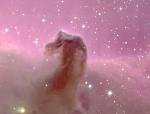
One of the most identifiable nebulae in the sky, the Horsehead Nebula in Orion, is part of a large, dark, molecular cloud. Also known as Barnard 33, the unusual shape was first discovered on a photographic plate in the late 1800s.
 PKS 1127 145: Quasar View
8.02.2002
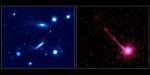
The quasar known as PKS 1127-145 lies ten billion light-years from our fair planet. A Hubble Space Telescope view in the left panel shows this quasar along with other galaxies as they appear in optical light. The quasar itself is the brightest object in the lower right corner.
 Blue Sun Glaring
6.01.1997
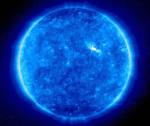
The Sun is a bubbling ball of extremely hot gas. In this false-color picture, light blue regions are extremely hot - over 1 million degrees, while dark blue regions are slightly cooler. The camera filter used was highly sensitive to the emission of highly charged iron ions, which trace the magnetic field of the Sun.
 Solstice Sun In Soft X-rays
21.12.1998
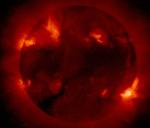
The solstice occurs today at 8:56 PM Eastern Standard Time. At the solstice the sun reaches its most southerly position in the sky and winter begins for the Northern Hemisphere while summer starts South of the Equator.
|
January February March April May June July August September October |
|||||||||||||||||||||||||||||||||||||||||||||||||