
|
You entered: Observatory
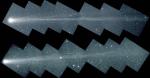 Comet NEAT Approaches the Sun
10.02.2003
A comet may likely become visible to the unaided eye over the next few days above the horizon where the Sun has just set. Comet NEAT (C/ 2002 V1), discovered last November, has brightened dramatically as it approached the Sun.
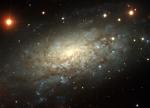 NGC 3621: Far Beyond the Local Group
19.07.2003
Far beyond the local group of galaxies lies NGC 3621, some 22 million light-years away. Found in the serpentine southern constellation Hydra, the loose spiral arms of this gorgeous island universe are loaded with luminous young star clusters and dark dust lanes.
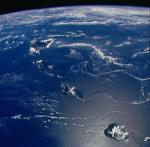 Hawaii
25.07.1998
Aloha! With the graceful arc of the Earth's limb in the background, the Hawaiian Island archipelago is visible in this stunning photo taken by the astronauts onboard the shuttle Discovery in October of 1988. Along with popular beaches and tropical resorts, these volcanic islands offer extreme elevations with dark, dry, cloudless skies.
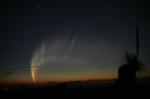 The Magnificent Tail of Comet McNaught
22.01.2007
Comet McNaught, the Great Comet of 2007, has grown a long and filamentary tail. The spectacular tail spreads across the sky and is visible to Southern Hemisphere observers just after sunset. The head of the comet remains quite bright and easily visible to even city observers without any optical aide.
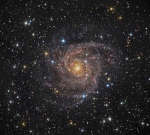 Hidden Galaxy IC 342
22.12.2010
Similar in size to other large, bright spiral galaxies, IC 342 is a mere 7 million light-years distant in the long-necked, northern constellation Camelopardalis. A sprawling island universe, IC 342 would otherwise...
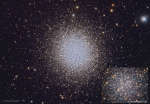 M13: A Great Globular Cluster of Stars
27.07.2016
M13 is one of the most prominent and best known globular clusters. Visible with binoculars in the constellation of Hercules, M13 is frequently one of the first objects found by curious sky gazers seeking celestials wonders beyond normal human vision.
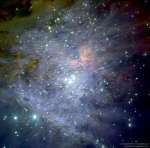 Magnetic Orion
27.02.2019
Can magnetism affect how stars form? Recent analysis of Orion data from the HAWC+ instrument on the airborne SOFIA observatory indicate that, at times, it can. HAWC+ is able to measure the polarization of far-infrared light which can reveal the alignment of dust grains by expansive ambient magnetic fields.
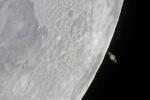 The Moon s Saturn
26.05.2007
On May 22nd, just days after sharing the western evening sky with Venus, the Moon moved on to Saturn - actually passing in front of the ringed planet when viewed in skies over Europe, northern Africa, and western Asia.
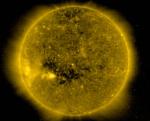 Hole in the Sun
27.09.2007
The dark expanse below the equator of the Sun is a coronal hole -- a low density region extending above the surface where the solar magnetic field opens freely into interplanetary space. Shown in false color, the picture was recorded on September 19th in extreme ultraviolet light by the EIT instrument onboard the space-based SOHO observatory.
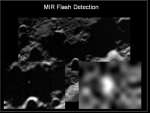 LCROSS Centaur Impact Flash
10.10.2009
This mid-infrared image was taken in the last minutes of the LCROSS flight mission to the Moon. The small white spot (enlarged in the insets) seen within the dark shadow of lunar crater walls is the initial flash created by the impact of a spent Centaur upper stage rocket.
|
January February March April May June July August September October |
|||||||||||||||||||||||||||||||||||||||||||||||||