
|
You entered: Observatory
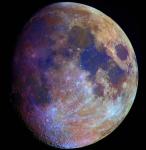 The Color of the Moon
16.02.2006
Earth's Moon is normally seen in subtle shades of grey or yellow. But small color differences have been greatly exaggerated to make this dramatic mosaic image of the Moon's gibbous phase. The familiar Sea of Tranquility (Mare Tranquillitatis) is the blue area right of center.
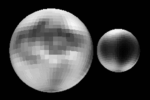 Mysterious Pluto and Charon
9.04.2000
Pluto is the only planet in our Solar System remaining unphotographed by a passing spacecraft. Distant Pluto and its moon Charon therefore remain somewhat mysterious. In addition to direct imaging by the Hubble Space...
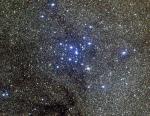 The M7 Open Star Cluster in Scorpius
5.04.2000
M7 is one of the most prominent open clusters of stars on the sky. The cluster, dominated by bright blue stars, can be seen with the naked eye in a dark sky in the tail of the constellation of Scorpius.
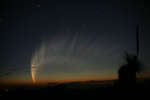 The Magnificent Tail of Comet McNaught
6.12.2009
Comet McNaught, the Great Comet of 2007, was the brightest comet of the last 40 years. Its spectacular tail spread across the sky and was breathtaking to behold from dark locations for many Southern Hemisphere observers.
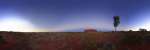 Sunset, Shadowrise
29.07.2010
From central Australia, this serene 360 degree panorama follows a clear horizon as twilight began on May 28. At left, a bright western sky is still illuminated by the setting Sun. But sweeping right...
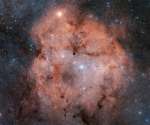 IC 1396: Emission Nebula in Cepheus
5.08.2012
Stunning emission nebula IC 1396 mixes glowing cosmic gas and dark dust clouds in the high and far off constellation of Cepheus. Energized by the bright, bluish central star seen here, this star forming region sprawls across hundreds of light-years -- spanning over three degrees on the sky while nearly 3,000 light-years from planet Earth.
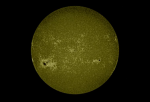 Sunspot Group AR 2192 Crackles
22.10.2014
One of the largest sunspot groups in recent years is now crossing the Sun. Labelled Active Region 2192, it has already thrown a powerful solar flare and has the potential to produce more.
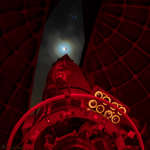 Great Refractor and Lunar Eclipse
26.11.2021
Rain clouds passed and the dome of the Lick Observatory's 36 inch Great Refractor opened on November 19. The historic telescope was pointed toward a partially eclipsed Moon. Illuminated by dim red lighting...
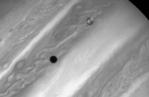 Io's Shadow
7.10.1996
Caught in the act earlier this summer by the Hubble Space Telescope, the volcanic moon Io (above and right of center) and its shadow (black dot) are seen here against Jupiter's clouds.
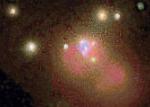 The Center of the Circinus Galaxy in X Rays
16.05.2001
Are black holes the cause of X-rays that pour out from the center of the Circinus galaxy? A new high-resolution image from the orbiting Chandra X-ray Observatory has resolved the inner regions of this nearby galaxy into several smaller sources. The image is shown above in representative-color.
|
January February March April May June July August September October |
|||||||||||||||||||||||||||||||||||||||||||||||||