
|
You entered: Observatory
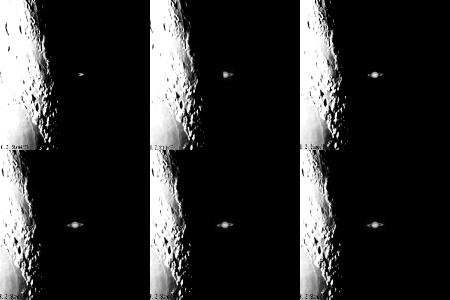 Moon Occults Saturn
8.09.2001
On September 18, 1997, many stargazers in the U. S. were able to watch a lovely early morning lunar occultation as a bright Moon passed in front of Saturn. Using a 1.2 meter reflector, astronomer Kris Stanek had an excellent view of this dream-like event from the Whipple Observatory atop Arizona's Mount Hopkins.
 Irregular Dwarf Galaxy Sextans A
29.05.2025
Grand spiral galaxies often seem to get all the attention, flaunting young, bright, blue star clusters and pinkish star forming regions along graceful, symmetric spiral arms. But small galaxies form stars too, like irregular dwarf galaxy Sextans A.
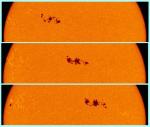 Sunspot Region 30
18.07.2002
The solar active region designated number 0030 is now appearing on the visible hemisphere of the closest star. Dwarfed by the Sun's disk, the group of sunspots which make up region 30 actually cover an enormous area -- nearly 10 times the size of Earth.
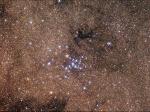 The M7 Open Star Cluster in Scorpius
6.04.2005
M7 is one of the most prominent open clusters of stars on the sky. The cluster, dominated by bright blue stars, can be seen with the naked eye in a dark sky in the tail of the constellation of Scorpius.
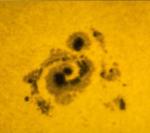 Spiral Sunspot
4.02.1999
Spiral galaxies abound in the universe, but spiral sunspots are definitely an unusual twist. This distinctive spiral-shaped sunspot caught the attention of National Solar Observatory astronomers and was photographed on February 19, 1982 with the Vacuum Solar Telescope on Kitt Peak.
 3D Mercury Transit
25.11.2006
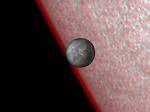
Mercury is now visible shortly before dawn, the brightest "star" just above the eastern horizon. But almost two weeks ago Mercury actually crossed the face of the Sun for the second time in the 21st century.
 Comet Lulin and Distant Galaxies
7.03.2009
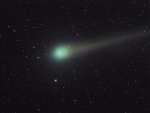
Now fading in our night sky, Comet Lulin has provided some lovely cosmic vistas. Moving rapidly against the background of stars, Lulin briefly posed with the likes of Saturn, and Regulus (Alpha Leo). But here it is seen against a field of distant galaxies.
 Anticrepuscular Rays at the Planet Festival
19.07.2024
For some, these subtle bands of light and shadow stretched across the sky as the Sun set on July 11. Known as anticrepuscular rays, the bands are formed as a large cloud bank near the western horizon cast long shadows through the atmosphere at sunset.
 The Iron Sun
21.05.1996
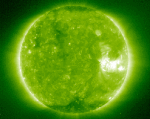
The ultraviolet light emitted by eleven times ionized iron at temperatures over 2 million degrees Farenheit was used to record the above picture of the Sun on May 16. The image was made by the EIT camera onboard the SOHO spacecraft, a space observatory which can continuously observe the Sun.
 The Perseus Cluster of Galaxies
30.12.2005
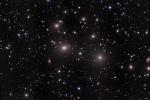
Here is one of the largest objects that anyone will ever see on the sky. Each of these fuzzy blobs is a galaxy, together making up the Perseus Cluster, one of the closest clusters of galaxies. The cluster is seen through a foreground of faint stars in our own Milky Way Galaxy.
|
January February March April May June July August September October |
|||||||||||||||||||||||||||||||||||||||||||||||||