
|
You entered: Observatory
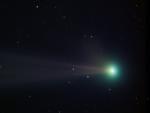 Colors of Comet Pojmanski
11.03.2006
Comet Pojmanski flew by planet Earth last weekend on a surprise trip through the inner solar system. Then an easy binocular target for morning skygazers, Pojmanski ultimately showed off a long tail, but it also presented some lovely green-blue hues as gas molecules in its tenuous coma and tail fluoresced in the sunlight.
 Deploying Spartan
12.08.1999
Last October the Space Shuttle Discovery deployed Spartan 201, a spacecraft that monitored the corona of the Sun. Instruments on Spartan 201 were used to estimate the density of electrons emitted into the solar...
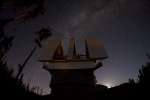 Large Binocular Telescope
16.02.2008
With moonlight on the horizon, a starry sky and the northern Milky Way provide the background for this dramatic view of the World at Night. The imposing structure in the foreground houses the Large Binocular Telescope (LBT), on Mount Graham, Arizona.
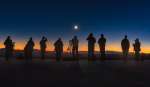 In the Shadow of the Moon
4.07.2019
On July 2 denizens of planet Earth could stand in the Moon's dark umbral shadow during South America's 2019 total solar eclipse. It first touched down in the Southern Pacific Ocean, east of New Zealand.
 Eclipse at Sunrise
3.10.2024
The second solar eclipse of 2024 began in the Pacific. On October 2nd the Moon's shadow swept from west to east, with an annular eclipse visible along a narrow antumbral shadow path tracking mostly over ocean, crossing land near the southern tip of South America, and ending in the southern Atlantic.
 The Long Jet of Pictor A
19.06.2000
A jet stretching nearly a million light years has been imaged emanating from galaxy Pictor A. The thin jet of electrons and protons shoots out at nearly light-speed likely from the vicinity of a large black hole at the galaxy center.
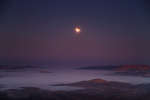 Eclipse at Moonset
9.10.2014
The Pacific Ocean and Chilean coast lie below this sea of clouds. Seen through the subtle colors of the predawn sky a lunar eclipse is in progress above, the partially eclipsed Moon growing dark.
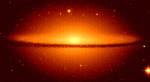 M104: The Sombrero Galaxy
9.11.1995
The famous Sombrero galaxy (M104) is a bright nearby spiral galaxy. The prominent dust lane and halo of stars and globular clusters give this galaxy its name. Something very energetic is going on in the Sombrero's center, as much X-ray light has been detected from it.
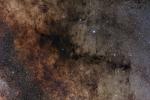 East of Antares
23.06.2006
East of Antares, dark markings seem to sprawl through the crowded star fields toward the center of our Milky Way Galaxy. Cataloged in the early 20th century by astronomer E. E. Barnard, the obscuring interstellar dust clouds include B72, B77, B78, and B59, seen in silhouette against the starry background.
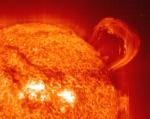 Equinox and Eruptive Prominence
23.09.1999
Today, the Sun crosses the celestial equator and seasons change from Summer to Fall in the north and Winter to Spring in the southern hemisphere. Defined by the Sun's position in sky the event is known as an equinox - the length of daylight is equal to the length of night.
|
January February March April May June July August September October |
|||||||||||||||||||||||||||||||||||||||||||||||||