
|
You entered: Observatory
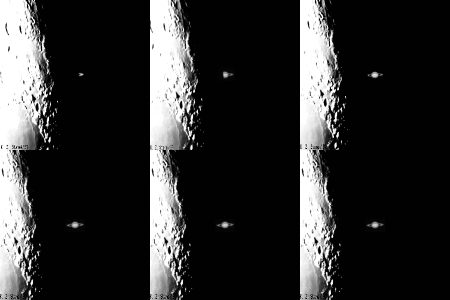 Moon Occults Saturn
24.09.1997
Many stargazers in the U. S. were able to watch a lovely lunar occultation early last Thursday morning as a bright Moon passed in front of Saturn. Using a 1.2 meter reflector, astronomer Kris Stanek had an excellent view of this dream-like event from the Whipple Observatory atop Arizona's Mount Hopkins.
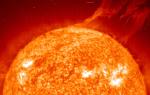 Eruptive Prominence
8.07.1999
Activity on our parent star continues to increase as the sun approaches a maximum in its 11-year solar cycle, expected in the year 2000. On June 14 - only a week before the solstice - the space-based SOHO observatory recorded this stunning view of an immense prominence erupting from the sun's southern latitudes (south is up).
 Pyrenees Paraselene
11.06.2009
A sea of clouds laps at rugged moutain peaks of the French Pyrenees in this serene view from Pic du Midi Observatory. The time exposure was recorded on June 4, with the constellations Sagittarius and Scorpius shining in the starry night. At the top right lies a faint, but colorful moondog or paraselene.
 Lightning on Earth
18.08.2004
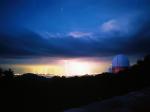
Nobody knows what causes lightning. It is known that charges slowly separate in some clouds causing rapid electrical discharges (lightning), but how electrical charges get separated in clouds remains a topic of much research.
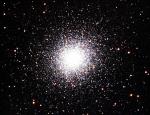 M13: The Great Globular Cluster in Hercules
1.03.2000
M13 is one of the most prominent and best known globular clusters. Visible with binoculars in the constellation of Hercules, M13 is frequently one of the first objects found by curious sky gazers seeking celestials wonders beyond normal human vision.
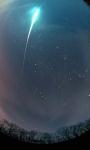 A Leonid Bolide Over Kansas
25.11.1998
The 1998 Leonid Meteor Shower featured many bright events. Extremely bright meteors, known as bolides or fireballs, can briefly glow brighter than the full moon. Pictured above is a Leonid bolide caught during a five-minute, wide-angle exposure. The bolide was so bright it lit up the surrounding area, making otherwise dark trees visible.
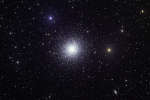 M13: A Great Globular Cluster of Stars
17.06.2009
M13 is one of the most prominent and best known globular clusters. Visible with binoculars in the constellation of Hercules, M13 is frequently one of the first objects found by curious sky gazers seeking celestials wonders beyond normal human vision.
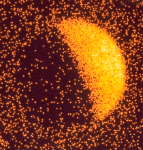 The X-Ray Moon
29.09.1996
This X-Ray image of the Moon was made by the orbiting Roentgen Observatory Satellite (ROSAT) in 1990. It shows three distinct regions: a bright X-ray sky, a bright part of the Moon, and a relatively dark part of the Moon. The bright X-ray sky is due to the diffuse cosmic X-ray background.
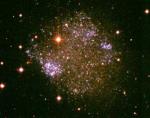 Irregular Galaxy Sextans A
18.12.1999
Grand spiral galaxies often seem to get all the glory. Their newly formed, bright, blue star clusters found along beautiful, symmetric spiral arms are guaranteed to attract attention. But small irregular galaxies form stars too, like this lovely, gumdrop-shaped galaxy, Sextans A.
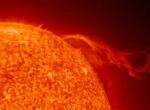 Escape From The Sun
20.11.1997
Twisted magnetic fields arching from the solar surface can trap ionized gas, suspending it in huge looping structures. These majestic plasma arches are seen as prominences above the solar limb. On September 14, this...
|
January February March April May June July August September October |
|||||||||||||||||||||||||||||||||||||||||||||||||