
|
You entered: atmosphere
 The Weather on Neptune
28.10.1996
Today's weather on Neptune will be typical. Highs in the upper atmosphere will be about -150 Centigrade, with winds ranging about 900 miles per hour near the equator. Much was learned recently about Neptune's weather by the release last week of time-lapse pictures of the most distant gas giant in our Solar System.
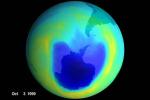 Ozone Hole Reduced
13.10.1999
Although a new ozone hole has formed again this year over the South Pole, this time it is a little bit smaller than the year before. Ozone is important because it shields us from damaging ultraviolet sunlight. Ozone is vulnerable, though, to CFCs and halons being released into the atmosphere.
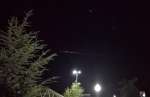 A Rocket Booster Falls Back to Earth
2.08.2016
What's that crossing the sky? Although it looked a bit like a large meteor, it was actually the booster of a Chinese rocket returning to Earth after its launch two days earlier.
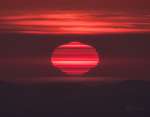 Layer Cake Sunset
20.01.2017
On January 18 a tantalizing sunset was captured in this snapshot. Seemingly sliced into many horizontal layers the Sun shimmered moments before it touched the horizon, setting over the Pacific Ocean as seen from the mountaintop Las Campanas Observatory in Chile.
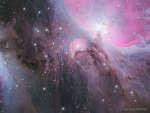 M43: Streams of Orion
6.10.2021
Where do the dark streams of dust in the Orion Nebula originate? This part of the Orion Molecular Cloud Complex, M43, is the often imaged but rarely mentioned neighbor of the more famous M42. M42, seen in part to the upper right, includes many bright stars from the Trapezium star cluster.
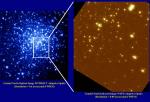 NGC 6934 from Gemini North
30.06.1999
What's going on near the center of globular cluster NGC 6934? The blur caused by the Earth's atmosphere has prevented astronomers from discerning individual stars in this unusual environment. Telescopes in space can help, but the new Gemini North telescope took the above picture from the ground.
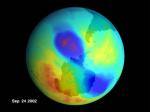 A Small Double Ozone Hole in 2002
22.10.2002
As expected, the ozone hole near Earth's South Pole is back again this year. This time, however, it's smaller than the past two years, and has an unusual double lobe structure. Ozone is important because it shields us from damaging ultraviolet sunlight.
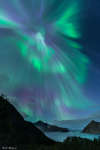 Auroral Corona over Norway
14.10.2014
Higher than the highest mountain lies the realm of the aurora. Auroras rarely reach below 60 kilometers, and can range up to 1000 kilometers. Aurora light results from energetic electrons and protons striking atoms and molecules in the Earth's atmosphere.
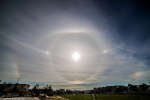 Ice Halos at Yellowknife
14.09.2018
You've probably seen a circle around the Sun before. More common than rainbows, ice halos, like a 22 degree circular halo for example, can be easy to spot, especially if you can shade your eyes from direct sunlight.
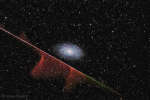 APOD: 2024 July 14 Б Meteor Misses Galaxy
14.07.2024
The galaxy was never in danger. For one thing, the Triangulum galaxy (M33), pictured, is much bigger than the tiny grain of rock at the head of the meteor. For another, the galaxy is much farther away -- in this instance 3 million light years as opposed to only about 0.0003 light seconds.
|
January February March April May June July August September October |
|||||||||||||||||||||||||||||||||||||||||||||||||