
|
You entered: atmosphere
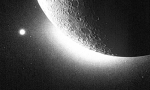 Sunshine, Earthshine at the Lunar Limb
30.05.1996
This dramatic image of the Moon's edge against a background of distant stars is from a perspective impossible for groundbased telescopes. It was taken by a star tracker camera onboard the Clementine spacecraft.
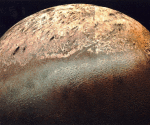 Triton: Neptune's Largest Moon
23.11.1997
On October 10th, 1846, William Lassell was observing the newly discovered planet Neptune. He was attempting to confirm his observation, made just the previous week, that Neptune had a ring. But this time he discovered that Neptune had a satellite as well.
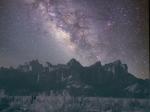 Heaven on Earth
23.02.2004
If sometimes it appears that the entire Milky Way Galaxy is raining down on your head, do not despair. It happens twice a day. As the Sun rises in the East, wonders of the night sky become less bright than the sunlight scattered by our own Earth's atmosphere, and so fade from view.
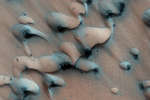 Sand Dunes Thawing on Mars
3.03.2008
What are these strange shapes on Mars? Defrosting sand dunes. As spring now dawns on the Northern Hemisphere of Mars, dunes of sand near the pole, as pictured above, are beginning to thaw. The carbon dioxide and water ice actually sublime in the thin atmosphere directly to gas.
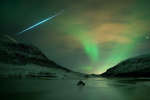 Aurora Shimmer, Meteor Flash
19.12.2009
Northern Lights, or aurora borealis, haunted skies over the island of Kvaløya, near Tromsø Norway on December 13. This 30 second long exposure records their shimmering glow gently lighting the wintery coastal scene.
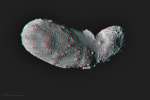 Stereo Itokawa
19.06.2010
Get out your red/blue glasses and float next to asteroid Itokawa, a diminutive world of the solar system only half a kilometer across. Boulders strewn across its rough surface and the lack of craters indicate that this asteroid is a rubble pile, formed as smaller pieces collected and were kept together by gravity.
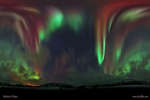 A Full Sky Aurora Over Norway
3.01.2012
Higher than the highest building, higher than the highest mountain, higher than the highest airplane, lies the realm of the aurora. Auroras rarely reach below 60 kilometers, and can range up to 1000 kilometers. Aurora light results from energetic electrons and protons striking molecules in the Earth's atmosphere.
 Jyvцskylц in the Sky
25.01.2024
You might not immediately recognize this street map of a neighborhood in Jyvцskylц, Finland, planet Earth. But that's probably because the map was projected into the night sky and captured with an allsky camera on January 16. The temperature recorded on that northern winter night was around minus 20 degrees Celsius.
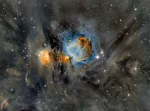 Orion Nebula in Surrounding Dust
25.03.2014
What surrounds a hotbed of star formation? In the case of the Orion Nebula -- dust. The entire Orion field, located about 1600 light years away, is inundated with intricate and picturesque filaments of dust.
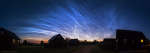 Veins of Heaven
31.07.2014
Transfusing sunlight through a a still dark sky, this exceptional display of noctilucent clouds was captured earlier this month above the island of Gotland, Sweden. From the edge of space, about 80 kilometers above...
|
January February March April May June July August September October |
|||||||||||||||||||||||||||||||||||||||||||||||||