
|
You entered: nucleus
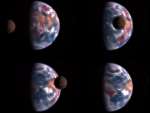 31 Million Miles from Planet Earth
3.09.2008
On July 4th, 2005, the Deep Impact spacecraft directed a probe to impact the nucleus of Comet Tempel 1. Still cruising through the solar system, earlier this year the robotic spacecraft looked back to record a series of images of its home world 31 million miles (50 million kilometers) away.
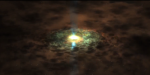 The Cloudy Cores of Active Galaxies
24.02.2014
What would it look like to travel to the center of an active galaxy? Most galactic centers are thought to house black holes millions of times more massive than our Sun. The spaces surrounding...
 APOD: 2024 September 25 Б Comet A3 Through an Australian Sunrise
25.09.2024
Comet Tsuchinshan-ATLAS is now visible in the early morning sky. Diving into the inner Solar System at an odd angle, this large dirty iceberg will pass its closest to the Sun -- between the orbits of Mercury and Venus -- in just two days.
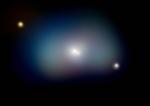 NGC 1700: Elliptical Galaxy and Rotating Disk
16.01.2003
In spiral galaxies, majestic winding arms of young stars and interstellar gas and dust rotate in a disk around a bulging galactic nucleus. Elliptical galaxies seem to be simpler, randomly swarming with old stars and lacking gas and dust.
 The Swirling Core of the Crab Nebula
8.07.2016
At the core of the Crab Nebula lies a city-sized, magnetized neutron star spinning 30 times a second. Known as the Crab Pulsar, it's actually the rightmost of two bright stars, just below a central swirl in this stunning Hubble snapshot of the nebula's core.
 APOD: 2025 March 11 Б NGC 1672: Barred Spiral Galaxy from Hubble
11.03.2025
Many spiral galaxies have bars across their centers. Even our own Milky Way Galaxy is thought to have a modest central bar. Prominently barred spiral galaxy NGC 1672, featured here, was captured in spectacular detail in an image taken by the orbiting Hubble Space Telescope.
 Gas and Snow Jets from Comet Hartley 2
23.11.2010
Unusual jets have been discovered emanating from Comet Hartley 2. The EPOXI spacecraft imaged the jets in unprecedented detail during its flyby of the comet earlier this month. Pictured above, sun-illuminated jets shoot away from the two-kilometer long decaying iceberg that orbits the Sun between Earth and Jupiter.
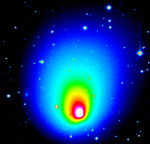 Hale-Bopp on Schedule
25.07.1996
Late March and early April of 1996 marked a banner season for viewing the spectacular naked-eye comet Hyakutake. The spring of 1997 could well offer a similar cometary wonder, Comet Hale-Bopp. Discovered last year while approaching the inner solar sytem Hale-Bopp has been eagerly watched for signs that it will indeed brighten spectacularly.
 Starburst Galaxy M94 from Hubble
31.07.2022
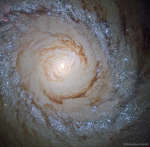
Why does this galaxy have a ring of bright blue stars? Beautiful island universe Messier 94 lies a mere 15 million light-years distant in the northern constellation of the Hunting Dogs (Canes Venatici).
 Hale Bopp: A Continuing Tail
20.02.1998
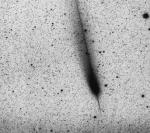
Where is Hale-Bopp now? The Great Comet of 1997, one of the largest and most active comets ever, is outbound about 400 million miles from the sun. Too faint for viewing without telescopes or binoculars, Hale-Bopp is presently positioned in the very southerly constellation of Pictor.
|
January February March April May June July August September |
|||||||||||||||||||||||||||||||||||||||||||||||||