
|
You entered: nucleus
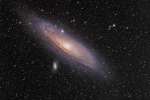 Andromeda Island Universe
9.01.2010
The most distant object easily visible to the eye is M31, the great Andromeda Galaxy some two and a half million light-years away. But without a telescope, even this immense spiral galaxy - spanning over 200,000 light years - appears as a faint, nebulous cloud in the constellation Andromeda.
 A Sudden Jet on Comet 67P?
18.11.2015
There she blows! A dramatic demonstration of how short-lived some comet jets can be was documented in late July by the robotic Rosetta spacecraft orbiting the nucleus of Comet 67P/Churyumov-Gerasimenko. The featured animation depicts changes in the rotating comet with three illuminating stills.
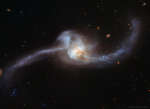 NGC 2623: Merging Galaxies from Hubble
10.01.2018
Where do stars form when galaxies collide? To help find out, astronomers imaged the nearby galaxy merger NGC 2623 in high resolution with the Hubble Space Telescope. Analysis of this and other Hubble images...
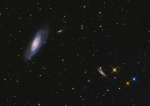 A View Toward M106
1.05.2020
Big, bright, beautiful spiral, Messier 106 dominates this cosmic vista. The nearly two degree wide telescopic field of view looks toward the well-trained constellation Canes Venatici, near the handle of the Big Dipper. Also...
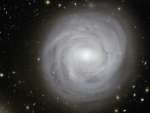 Anemic Galaxy NGC 4921 at the Edge
9.02.2009
How far away is spiral galaxy NGC 4921? Although presently estimated to be about 320 million light years distant, a more precise determination could be coupled with its known recession speed to help humanity better calibrate the expansion rate of the entire visible universe.
 Signed, "A Black Hole"
16.05.1997
This artistic image is actually the signature of a supermassive black hole in the center of distant galaxy M84 - based on data recently recorded by Hubble's new Space Telescope Imaging Spectrograph (STIS). Very...
 What are Comet Tails Made Of?
26.03.1996
The tail of comet Hyakutake, visible in this recent color image, is composed of dust and gas driven off the icy comet nucleus by the Sun's heat and blown away by the solar wind. Bathed in solar ultraviolet light, the gas molecules break down and are excited, producing a characteristic glow.
 Crab Pulsar Wind Nebula
27.12.2008
The Crab Pulsar, a city-sized, magnetized neutron star spinning 30 times a second, lies at the center of this remarkable image from the orbiting Chandra Observatory. The deep x-ray image gives the first clear view of the convoluted boundaries of the Crab's pulsar wind nebula.
 Anemic Spiral NGC 4921 from Hubble
25.11.2013
How far away is spiral galaxy NGC 4921? Although presently estimated to be about 310 million light years distant, a more precise determination could be coupled with its known recession speed to help humanity better calibrate the expansion rate of the entire visible universe.
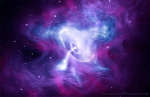 The Spinning Pulsar of the Crab Nebula
21.08.2022
At the core of the Crab Nebula lies a city-sized, magnetized neutron star spinning 30 times a second. Known as the Crab Pulsar, it is the bright spot in the center of the gaseous swirl at the nebula's core.
|
January February March April May June July August September |
|||||||||||||||||||||||||||||||||||||||||||||||||