
|
You entered: rings
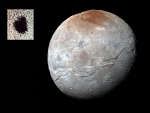 Charon: Moon of Pluto
6.07.2018
A darkened and mysterious north polar region known to some as Mordor Macula caps this premier high-resolution view. The portrait of Charon, Pluto's largest moon, was captured by New Horizons near the spacecraft's closest approach on July 14, 2015.
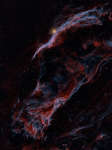 Along the Western Veil
19.09.2019
Delicate in appearance, these filaments of shocked, glowing gas, are draped across planet Earth's sky toward the constellation of Cygnus. They form the western part of the Veil Nebula. The Veil Nebula itself is a large supernova remnant, an expanding cloud born of the death explosion of a massive star.
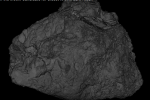 Found on the Moon: Candidate for Oldest Known Earth Rock
3.02.2021
Was the oldest known rock on Earth found on the Moon? Quite possibly. The story opens with the Apollo 14 lunar mission. Lunar sample 14321, a large rock found in Cone crater by astronaut...
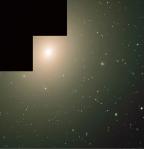 Young Star Clusters in an Old Galaxy
4.07.2002
Elliptical galaxy NGC 4365 is old, probably about 12 billion years old. Like most elliptical galaxies, this galaxy was thought to be full of old stars too, its burst of star forming activity having long since ended.
 The Colors of Comet Hyakutake
29.03.1996
The colors of Comet Hyakutake are caused by the action of sunlight on the dust and gas produced by the warming nucleus. The microscopic dust particles reflect sunlight while the sun's ultraviolet radiation excites and ionizes the gas molecules causing them to glow or fluoresce in a range of visible colors.
 The Nebula And The Neutron Star
1.02.2003
The lonely RX J1856.5-3754 was formed from the collapsed core of an exploding star. At a distance of 180 light-years it is the closest known neutron star. More massive than...
 Galaxy Cluster in the Early Universe
26.02.2004
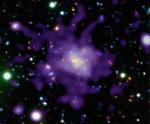
Long before medieval alchemists dreamed of transmuting base metals to gold, stellar furnaces in this massive cluster of galaxies - cataloged as RDCS 1252.9-2927 - had transformed light elements into heavy ones. In the false-color composite image individual cluster galaxies can be seen at optical and near-infrared wavelengths, shown in red, yellow, and green colors.
 Hubble s Messier 5
25.04.2014
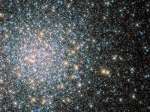
"Beautiful Nebula discovered between the Balance [Libra] & the Serpent [Serpens] ..." begins the description of the 5th entry in 18th century astronomer Charles Messier's famous catalog of nebulae and star clusters. Though it appeared...
 A Halo for NGC 6164
22.05.2014
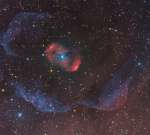
Beautiful emission nebula NGC 6164 was created by a rare, hot, luminous O-type star, some 40 times as massive as the Sun. Seen at the center of the cosmic cloud, the star is a mere 3 to 4 million years old.
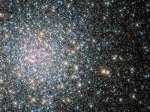 Hubble s Messier 5
20.06.2015
"Beautiful Nebula discovered between the Balance [Libra] & the Serpent [Serpens] ..." begins the description of the 5th entry in 18th century astronomer Charles Messier's famous catalog of nebulae and star clusters. Though it appeared...
|
January February March April May June July August September October |
|||||||||||||||||||||||||||||||||||||||||||||||||