
|
You entered: rings
 The Hydrogen Clouds of M33
30.09.2021
Gorgeous spiral galaxy M33 seems to have more than its fair share of glowing hydrogen gas. A prominent member of the local group of galaxies, M33 is also known as the Triangulum Galaxy and lies a mere 3 million light-years away.
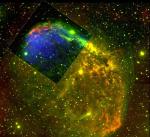 NGC 6888: X Rays in the Wind
16.10.2003
NGC 6888, also known as the Crescent Nebula, is a cosmic bubble of interstellar gas about 25 light-years across. Created by winds from the bright, massive star seen near the center of this composite image, the shocked filaments of gas glowing at optical wavelengths are represented in green and yellowish hues.
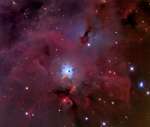 NGC 1999: South of Orion
24.02.2011
South of the large star-forming region known as the Orion Nebula, lies bright blue reflection nebula NGC 1999. Also at the edge of the Orion molecular cloud complex some 1,500 light-years distant, NGC 1999's illumination is provided by the embedded variable star V380 Orionis.
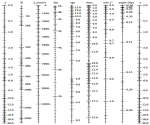 A Redshift Lookup Table for our Universe
8.04.2013
How far away is "redshift six"? Although humans are inherently familiar with distance and time, what is actually measured for astronomical objects is redshift, a color displacement that depends on exactly how energy density has evolved in our universe.
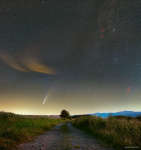 Comet NEOWISE and Nebulae
20.07.2020
Would you brave wild animals to photograph this sky? One astrophotographer did -- and we all get to reap the rewards. First, thousands of stars were visible with many of the brightest impressively blue. Next, several red-glowing nebulae were discernible, including the California Nebula on the far right, and, above it, the Heart and Soul nebulae.
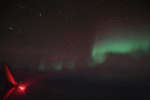 Quadrantid Meteors and Aurora from the Air
7.01.2008
Where do meteor showers originate? To help answer this question, astronomers studied in some detail the Quadrantid meteor shower that occurred over this past weekend. In particular, astronomers with specialized cameras flew as part...
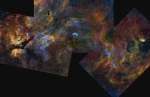 Cygnus Trio
7.11.2008
In this colorful mosaic, filaments of gas and dust span some 9 degrees across central Cygnus, a nebula rich constellation along the northern Milky Way. A trio of nebulae with popular names highlights the beautiful skyscape - the Butterfly, the Crescent, and the Tulip.
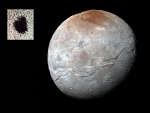 APOD: 2026 June 6 Б Charon: Moon of Pluto
6.06.2026
A darkened and mysterious north polar region known to some as Mordor Macula caps this premier view of Charon, Pluto's largest moon. The high-resolution image was captured by the interplanetary space probe New Horizons near its closest approach to distant Pluto on July 14, 2015.
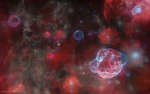 The Ghosts of Five Supernovas
24.09.2026
The ghosts of five supernovas haunt this extraordinary image. It was acquired at Oukaцmeden Observatory in Morocco with approximately 200 hours of observations and shows a large patch of the sky, equivalent to the area of one thousand full moons tiled together, in the constellation of Auriga (the charioteer).
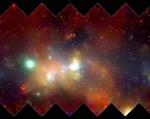 X Ray Milky Way
12.07.2003
If you had x-ray vision, the center regions of our Galaxy would not be hidden from view by the immense cosmic dust clouds opaque to visible light. Instead, the Milky Way toward Sagittarius might look something like this stunning mosaic of images from the orbiting Chandra Observatory.
|
January February March April May June July August September October |
|||||||||||||||||||||||||||||||||||||||||||||||||