
|
You entered: rings
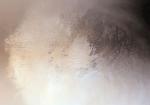 The South Pole of Mars
12.12.2001
The south pole of Mars is the bright area near the center of the detailed, subtly shaded color image above. Recorded in September of this year by the Mars Global Surveyor (MGS) spacecraft, the picture shows a region surrounding the 400 kilometer wide martian polar cap in the midst of southern hemisphere spring.
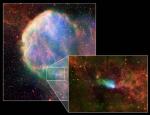 IC 443: Supernova Remnant and Neutron Star
2.06.2006
IC 443 is typical of the aftermath of a stellar explosion, the ultimate fate of massive stars. Seen in this false-color composite image, the supernova remnant is still glowing across the spectrum, from radio...
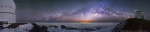 Mauna Kea Milky Way Panorama
18.02.2009
Aloha and welcome to a breathtaking skyscape. The dreamlike panoramic view looks out from the 4,200 meter volcanic summit of Mauna Kea, Hawai'i, across a layer of clouds toward a starry night sky and the rising Milky Way.
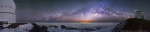 Milky Way Panorama from Mauna Kea
10.03.2013
Aloha and welcome to a breathtaking skyscape. The dreamlike panoramic view looks out from the 4,200 meter volcanic summit of Mauna Kea, Hawai'i, across a layer of clouds toward a starry night sky and the rising Milky Way.
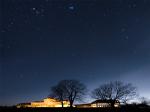 Mira Over Germany
20.02.2007
What's that new star in the sky? The star might appear new, but it's actually just the variable star Mira near its brightest. Rolling your cursor over the above vertically compressed image...
 APOD: 2023 October 10 Б Hidden Orion from Webb
9.10.2023
The Great Nebula in Orion has hidden stars. To the unaided eye in visible light, it appears as a small fuzzy patch in the constellation of Orion. But this image was taken by the Webb Space Telescope in a representative-color composite of red and very near infrared light.
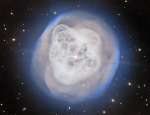 APOD: 2026 May 28 Б NGC 1514: The Crystal Ball Nebula
27.05.2026
What do you see in this crystal ball? The featured image shows NGC 1514, known as the Crystal Ball Nebula, observed by the Gemini North telescope on Maunakea, in Hawai'i. NGC 1514 is 1,500 light-years away and was discovered by William Herschel in 1790.
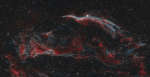 Along the Western Veil
5.09.2018
Delicate in appearance, these filaments of shocked, glowing gas, are draped across planet Earth's sky toward the constellation of Cygnus. They form the western part of the Veil Nebula. The Veil Nebula itself is a large supernova remnant, an expanding cloud born of the death explosion of a massive star.
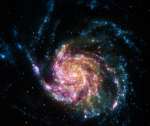 21st Century M101
13.07.2012
One of the last entries in Charles Messier's famous catalog, big, beautiful spiral galaxy M101 is definitely not one of the least. About 170,000 light-years across, this galaxy is enormous, almost twice the size of our own Milky Way Galaxy.
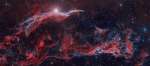 Along the Western Veil
4.04.2014
Delicate in appearance, these filaments of shocked, glowing gas, draped in planet Earth's sky toward the constellation of Cygnus, make up the western part of the Veil Nebula. The Veil Nebula itself is a large supernova remnant, an expanding cloud born of the death explosion of a massive star.
|
January February March April May June July August September October |
|||||||||||||||||||||||||||||||||||||||||||||||||