
|
You entered: light
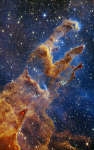 Pillars of Creation
20.10.2022
A now famous picture from the Hubble Space Telescope featured these star forming columns of cold gas and dust light-years long inside M16, the Eagle Nebula, dubbed the Pillars of Creation. This James Webb Space Telescope NIRCam image expands Hubble's exploration of that region in greater detail and depth inside the iconic stellar nursery.
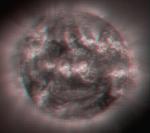 Stereo Sun
7.04.2001
This week's stereo offering features the now famous Active Region 9393, the largest sunspot group in the last 10 years. Viewed with red/blue glasses, the stereo pair of images merges into one 3D representation of the Sun with AR9393 above and right of center.
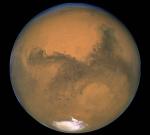 Big Mars from Hubble
27.08.2003
At about 10 am Universal Time today, Mars and Earth will pass closer than in nearly 60,000 years. Mars, noticeably red, will be the brightest object in the eastern sky just after sunset.
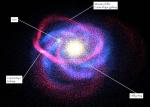 Canis Major Dwarf: A New Closest Galaxy
17.11.2003
What is the closest galaxy to the Milky Way? The new answer to this old question is the Canis Major dwarf galaxy. For many years astronomers thought the Large Magellan Cloud (LMC) was closest, but its title was supplanted in 1994 by the Sagittarius dwarf galaxy.
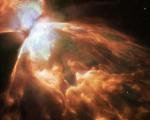 NGC 6302: Big Bright Bug Nebula
5.05.2004
The bright clusters and nebulae of planet Earth's night sky are often named for flowers or insects, and NGC 6302 is no exception. With an estimated surface temperature of about 250,000 degrees...
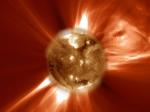 Sun Storm: A Coronal Mass Ejection
6.02.2007
What's happening to our Sun? Another Coronal Mass Ejection (CME)! The Sun-orbiting SOHO spacecraft has imaged many erupting filaments lifting off the active solar surface and blasting enormous bubbles of magnetic plasma into space.
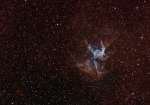 Thor s Helmet (NGC 2359) and Planetary Nebula
12.03.2009
At the right, Thor's Helmet (NGC 2359) seems to gaze across a lovely star field. The broad skyscape itself covers about 1.5 degrees or 3 full moons toward the constellation Canis Major.
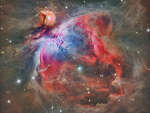 M42: Inside the Orion Nebula
20.03.2013
The Great Nebula in Orion, an immense, nearby starbirth region, is probably the most famous of all astronomical nebulas. Here, glowing gas surrounds hot young stars at the edge of an immense interstellar molecular cloud only 1500 light-years away.
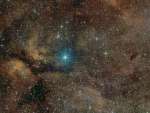 Supergiant Star Gamma Cygni
9.07.2013
Supergiant star Gamma Cygni lies at the center of the Northern Cross, a famous asterism in the constellation of the Swan (Cygnus). Known by the proper name Sadr, the bright star also lies...
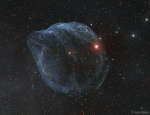 Sharpless 308: Star Bubble
20.12.2016
Blown by fast winds from a hot, massive star, this cosmic bubble is huge. Cataloged as Sharpless 2-308 it lies some 5,200 light-years away toward the constellation of the Big Dog (Canis Major) and covers slightly more of the sky than a full moon.
|
January February March April May June July August September October |
|||||||||||||||||||||||||||||||||||||||||||||||||