
|
You entered: light
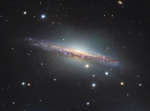 NGC 1055 Close up
8.11.2017
Big, beautiful spiral galaxy NGC 1055 is a dominant member of a small galaxy group a mere 60 million light-years away toward the aquatically intimidating constellation Cetus. Seen edge-on, the island universe spans over 100,000 light-years, a little larger than our own Milky Way.
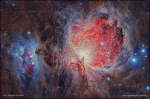 M42: The Great Orion Nebula
28.11.2017
Few astronomical sights excite the imagination like the nearby stellar nursery known as the Orion Nebula. The Nebula's glowing gas surrounds hot young stars at the edge of an immense interstellar molecular cloud.
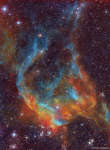 Stars, Dust, and Gas near NGC 3572
27.05.2019
Star formation can be colorful. This chromatic cosmic portrait features glowing gas and dark dust near some recently formed stars of NGC 3572, a little-studied star cluster near the Carina Nebula. Stars from...
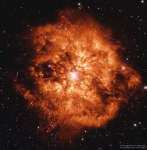 Wolf Rayet Star 124: Stellar Wind Machine
7.03.2020
Some stars explode in slow motion. Rare, massive Wolf-Rayet stars are so tumultuous and hot that they are slowly disintegrating right before our telescopes. Glowing gas globs each typically over 30 times more massive than the Earth are being expelled by violent stellar winds.
 Cygnus Without Stars
29.11.2020
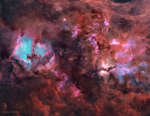
The sky is filled with faintly glowing gas, though it can take a sensitive camera and telescope to see it. For example, this twelve-degree-wide view of the northern part of the constellation Cygnus reveals a complex array of cosmic clouds of gas along the plane of our Milky Way galaxy.
 M64: The Evil Eye Galaxy
28.03.2021
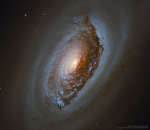
Who knows what evil lurks in the eyes of galaxies? The Hubble knows -- or in the case of spiral galaxy M64 -- is helping to find out. Messier 64, also known as the Evil...
 NGC 1893 and the Tadpoles of IC 410
1.02.2024
This cosmic view shows off an otherwise faint emission nebula IC 410, captured under clear Netherlands skies with telescope and narrowband filters. Above and right of center you can spot two remarkable inhabitants of the interstellar pond of gas and dust, known as the tadpoles of IC 410.
 At The Core Of M15
16.01.1998
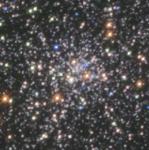
Densely packed stars in the core of the globular cluster M15 are shown in this Hubble Space Telescope (HST) image. The star colors roughly indicate their temperatures - hot stars appear blue, cooler stars look reddish-orange.
 Chandra Deep Field
12.10.2002
Officially the Chandra Deep Field - South, this picture represents the deepest ever x-ray image of the Universe. One million seconds of accumulated exposure time with the orbiting Chandra X-ray Observatory went in to its making.
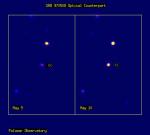 GRB970508 Delivers Predicted Radio Emission
21.05.1997
New evidence bolsters once controversial claims that Gamma-Ray Bursts (GRBs) are the most powerful explosions ever found by humanity. Two weeks ago, an average GRB became instantly historic when prompt, coincident X-ray and optical emissions were identified.
|
January February March April May June July August September October |
|||||||||||||||||||||||||||||||||||||||||||||||||