
|
You entered: light
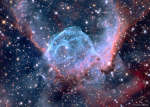 Thors Helmet Emission Nebula
1.11.2017
This helmet-shaped cosmic cloud with wing-like appendages is popularly called Thor's Helmet. Heroically sized even for a Norse god, Thor's Helmet spans about 30 light-years across. In fact, the helmet is more...
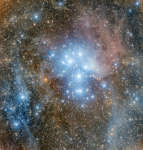 Messier 45: The Daughters of Atlas and Pleione
7.11.2019
Hurtling through a cosmic dust cloud a mere 400 light-years away, the lovely Pleiades or Seven Sisters open star cluster is well-known for its striking blue reflection nebulae. It lies in the night sky toward the constellation Taurus and the Orion Arm of our Milky Way Galaxy.
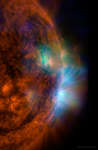 The Sun in X rays from NuSTAR
23.11.2021
Why are the regions above sunspots so hot? Sunspots themselves are a bit cooler than the surrounding solar surface because the magnetic fields that create them reduce convective heating. It is therefore unusual that regions overhead -- even much higher up in the Sun's corona -- can be hundreds of times hotter.
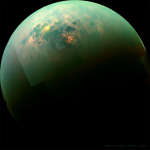 Titan Seas Reflect Sunlight
27.03.2022
Why would the surface of Titan light up with a blinding flash? The reason: a sunglint from liquid seas. Saturn's moon Titan has numerous smooth lakes of methane that, when the angle is right, reflect sunlight as if they were mirrors.
 The Nebulous Realm of WR 134
31.05.2024
Made with narrowband filters, this cosmic snapshot covers a field of view over twice as wide as the full Moon within the boundaries of the constellation Cygnus. It highlights the bright edge of a ring-like nebula traced by the glow of ionized hydrogen and oxygen gas.
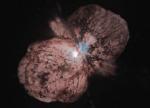 Doomed Star Eta Carinae
13.08.2000
Eta Carinae may be about to explode. But no one knows when - it may be next year, it may be one million years from now. Eta Carinae's mass - about 100 times greater than our Sun - makes it an excellent candidate for a full blown su
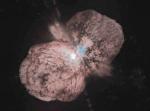 Doomed Star Eta Carinae
28.04.2002
Eta Carinae may be about to explode. But no one knows when - it may be next year, it may be one million years from now. Eta Carinae's mass - about 100 times greater than our Sun - makes it an excellent candidate for a full blown supernova.
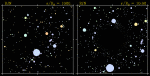 Too Close to a Black Hole
27.11.1995
What would you see if you went right up to a black hole? Above are two computer generated pictures highlighting how strange things would look. On the left is a normal star field containing the constellation Orion. Notice the three stars of nearly equal brightness that make up Orion's Belt.
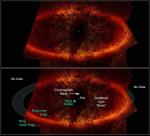 Ring Around Fomalhaut
1.07.2005
Fomalhaut (sounds like "foam-a-lot") is a bright, young, star, a mere 25 light-year trip from planet Earth in the direction of the constellation Piscis Austrinus. Earlier infrared observations identified a torus of cold material...
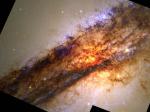 The Center of Centaurus A
29.07.2007
A fantastic jumble of young blue star clusters, gigantic glowing gas clouds, and imposing dark dust lanes surrounds the central region of the active galaxy Centaurus A. This mosaic of Hubble Space Telescope images taken in blue, green, and red light has been processed to present a natural color picture of this cosmic maelstrom.
|
January February March April May June July August September October |
|||||||||||||||||||||||||||||||||||||||||||||||||