
|
You entered: light
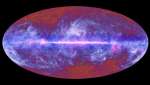 Microwave Milky Way
9.07.2010
Seen from our edge-on perspective, the Milky Way Galaxy sprawls across the middle of this false-color, all sky view. The expansive microwave map is based on 1 year's worth of data from instruments onboard the sky-surveying Planck spacecraft.
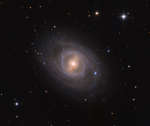 M95 with Supernova
22.03.2012
Barred spiral galaxy M95 is about 75,000 light-years across, comparable in size to our own Milky Way and one of the larger galaxies of the Leo I galaxy group. In fact, it is part of a not quite so famous trio of Leo galaxies with neighbors M96 and M105, about 38 million light-years distant.
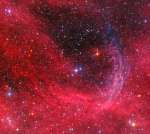 WR 134 Ring Nebula
21.06.2012
Made with narrow and broad band filters, this colorful cosmic snap shot covers a field of view about the size of the full Moon within the boundaries of the constellation Cygnus. It highlights the bright edge of a ring-like nebula traced by the glow of ionized hydrogen and oxygen gas.
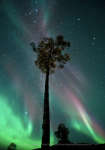 September Aurora
21.09.2012
September's equinox arrives tomorrow as the Sun crosses the celestial equator heading south. The event marks the astronomical beginning of spring in the southern hemisphere and autumn in the north. And though the connection is still puzzling, the equinox seasons bring an increase in geomagnetic storms.
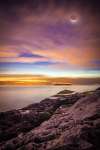 Moon, Venus, and Planet Earth
19.09.2013
In this engaging scene from planet Earth, the Moon shines through cloudy skies following sunset on the evening of September 8. Despite the fading light, the camera's long exposure still recorded a colorful, detailed view of a shoreline and western horizon looking toward the island San Gabriel from Colonia del Sacramento, Uruguay.
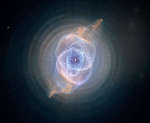 The Cat's Eye Nebula from Hubble
8.11.2014
To some, it may look like a cat's eye. The alluring Cat's Eye nebula, however, lies three thousand light-years from Earth across interstellar space. A classic planetary nebula, the Cat's Eye (NGC 6543) represents a final, brief yet glorious phase in the life of a sun-like star.
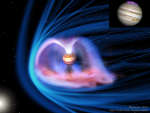 Auroras and the Magnetosphere of Jupiter
6.04.2016
Jupiter has auroras. Like near the Earth, the magnetic field of our Solar System's largest planet compresses when impacted by a gust of charged particles from the Sun. This magnetic compression funnels charged particles towards Jupiter's poles and down into the atmosphere.
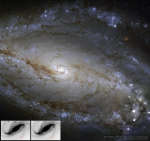 NGC 613 in Dust, Stars, and a Supernova
28.02.2018
Where did that spot come from? Amateur astronomer Victor Buso was testing out a new camera on his telescope in 2016 when he noticed a curious spot of light appear -- and remain. After reporting...
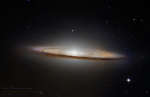 M104: The Sombrero Galaxy
29.03.2019
The striking spiral galaxy M104 is famous for its nearly edge-on profile featuring a broad ring of obscuring dust lanes. Seen in silhouette against an extensive central bulge of stars, the swath of cosmic dust lends a broad brimmed hat-like appearance to the galaxy suggesting a more popular moniker, The Sombrero Galaxy.
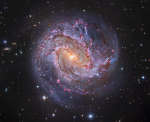 M83: The Thousand Ruby Galaxy
29.06.2019
Big, bright, and beautiful, spiral galaxy M83 lies a mere twelve million light-years away, near the southeastern tip of the very long constellation Hydra. Prominent spiral arms traced by dark dust lanes and blue star clusters lend this galaxy its popular name, The Southern Pinwheel.
|
January February March April May June July August September October |
|||||||||||||||||||||||||||||||||||||||||||||||||