
|
You entered: Earth
 APOD: 2023 April 30 Б Saturns Moon Helene in Color
30.04.2023
Although its colors may be subtle, Saturn's moon Helene is an enigma in any light. The moon was imaged in unprecedented detail in 2012 as the robotic Cassini spacecraft orbiting Saturn swooped to within a single Earth diameter of the diminutive moon.
 APOD: 2024 October 7 Б The Long Tails of Comet Tsuchinshan ATLAS
7.10.2024
A bright comet is moving into the evening skies. C/2023 A3 (TsuchinshanБATLAS) has brightened and even though it is now easily visible to the unaided eye, it is so near to the Sun that it is still difficult to see. Pictured, Comet TsuchinshanБATLAS was captured just before sunrise from an Andes Mountain in Peru.
 A December Winter Night
28.12.2024
Orion seems to come up sideways, climbing over a distant mountain range in this deep skyscape. The wintry scene was captured from southern Poland on the northern hemisphere's long solstice night. Otherwise unseen nebulae hang in the sky, revealed by the camera modified to record red hydrogen-alpha light.
 APOD: 2025 September 4 Б NGC 4565: Galaxy on Edge
4.09.2025
Magnificent spiral galaxy NGC 4565 is viewed edge-on from planet Earth. Also known as the Needle Galaxy for its narrow profile, bright NGC 4565 is a stop on many telescopic tours of the northern sky, in the faint but well-groomed constellation Coma Berenices.
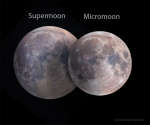 APOD: 2026 May 30 Б Supermoon Versus Micromoon
30.05.2026
What is so micro about tonight's blue micromoon? Just after sunset, a full moon will appear slightly smaller and dimmer than usual. The reason is that the Moon's fully illuminated phase occurs within a short time of apogee - when the Moon is farthest from the Earth in its elliptical orbit.
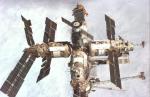 Mir Above
3.07.1998
Photographed from the approaching Space Shuttle Endeavour, the Mir space station floats above the clouds of planet Earth. Mir's modular construction, bristling with solar panels and antennas, lends it a slightly whimsical, insect-like appearance.
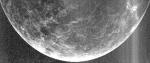 A Radar Image of Venus
15.05.2001
The largest radio telescopes in the world are working together to create a new map of the surface of Venus. The surface of Venus is unusually hidden by a thick atmosphere of mostly carbon dioxide gas. These thick clouds are transparent, however, to radar signals sent and received from Earth.
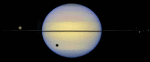 Saturn's Rings Seen Sideways
29.04.1996
Saturn's rings are actually very thin. This picture from the Hubble Space Telescope was taken on August 6, 1995 when the rings lined up sideways as seen from Earth. Saturn's largest moon Titan is seen on the left, and Titan's shadow can be seen on Saturn's cloud tops!
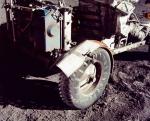 Lunar Dust and Duct Tape
17.04.2004
Why is the Moon dusty? On Earth, rocks are weathered by wind and water, creating soil and sand. On the Moon, the long history of micrometeorite bombardment has blasted away at the rocky surface creating a layer of powdery lunar soil or regolith. This lunar regolith could be a scientific and industrial bonanza.
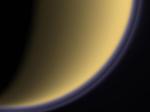 The Double Haze above Titan
10.08.2004
Most moons have no haze layer at all - why does Titan have two? Images from the Cassini spacecraft that slipped into orbit around Saturn last month confirm that the Solar System's most mysterious moon is surrounded not only by a thick atmosphere but also by two distinct spheres of haze.
|
January February March April May June July August September October |
|||||||||||||||||||||||||||||||||||||||||||||||||