
|
You entered: Earth
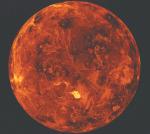 The North Pole of Venus
14.05.2003
If you could look down on the North Pole of Venus what would you see? The Magellan probe that orbited Venus from 1990 to 1994 was able to peer through the thick Venusian clouds and build up the above image by emitting and re-detecting cloud-penetrating radar.
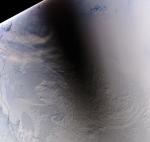 The Long Shadow of the Moon
27.11.2003
The long shadow of the Moon fell across the continent of Antarctica on November 23rd, during the second total solar eclipse of 2003. In this view from orbit, based on data from the MODIS instrument on board the Earth observing Aqua satellite, the Moon's shadow stretches for almost 500 kilometers.
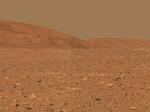 Spirit Rover Reaches the Columbia Hills on Mars
28.06.2004
The Spirit robotic rover on Mars has now reached the Columbia Hills on Mars. Two of the hills are shown on approach near the beginning of June. The above true-color picture shows very nearly what a human would see from Spirit's vantage point.
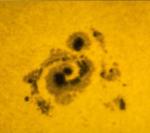 Spiral Sunspot
4.02.1999
Spiral galaxies abound in the universe, but spiral sunspots are definitely an unusual twist. This distinctive spiral-shaped sunspot caught the attention of National Solar Observatory astronomers and was photographed on February 19, 1982 with the Vacuum Solar Telescope on Kitt Peak.
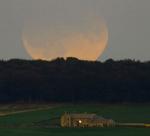 Eclipsed Moon Rising Over England
11.09.2006
Last Thursday, part of our Moon turned dark. The cause, this time, was not a partial lunar phase -- the Moon was full -- but rather that part of the Moon went into Earth's shadow.
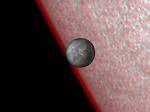 3D Mercury Transit
25.11.2006
Mercury is now visible shortly before dawn, the brightest "star" just above the eastern horizon. But almost two weeks ago Mercury actually crossed the face of the Sun for the second time in the 21st century.
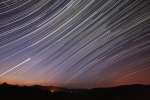 Star Trails at Dawn
8.12.2007
Just fix your camera to a tripod and you too can make an image of graceful trails traced by the stars as planet Earth rotates on its axis. Made on September 14 from Montlaux...
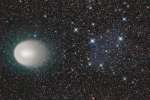 Amazing Comet Holmes
24.10.2008
One year ago, Comet 17P/Holmes amazed sky watchers across planet Earth. A stunningly rapid outburst transformed it from a faint comet quietly orbiting the Sun with a period of about 7 years to a naked-eye comet rivaling the brighter stars in the constellation Perseus.
 Smile in the Sky
5.12.2008
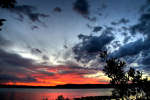
At sunset, Monday's western sky showed off stunning colors and dramatic clouds reflected in Brisbane Water on the Central Coast of New South Wales, Australia. It also featured the remarkable conjunction of the crescent Moon, Venus, and Jupiter forming a twilight smiley face.
 Comet Lulin and Distant Galaxies
7.03.2009
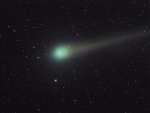
Now fading in our night sky, Comet Lulin has provided some lovely cosmic vistas. Moving rapidly against the background of stars, Lulin briefly posed with the likes of Saturn, and Regulus (Alpha Leo). But here it is seen against a field of distant galaxies.
|
January February March April May June July August September October |
|||||||||||||||||||||||||||||||||||||||||||||||||