
|
You entered: Earth
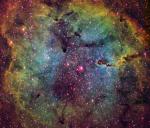 Emission Nebula IC 1396
5.08.2004
Sprawling across hundreds of light-years, emission nebula IC 1396 mixes glowing cosmic gas and dark dust clouds. Stars are forming in this area, only about 3,000 light-years from Earth. This particularly colorful view of the region is a composite of digital images recorded through narrow band filters.
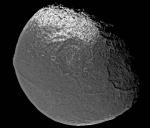 Saturns Iapetus: Moon with a Strange Surface
1.02.2005
What has happened to Saturn's moon Iapetus? A strange ridge crosses the moon near the equator, visible near the bottom of the above image, making Iapetus appear similar to the pit of a peach. Half of Iapetus is so dark that it can nearly disappear when viewed from Earth.
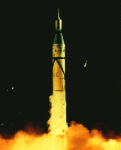 The First Explorer
6.02.1999
The first US spacecraft was Explorer 1. The cylindrical 30 pound satellite was launched (above) as the fourth stage of a Jupiter-C rocket (a modified US Army Redstone ballistic missile) and achieved orbit on January 31, 1958.
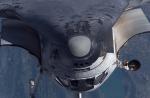 A Shuttle Back Flip at the Space Station
2.08.2005
Last week, crew members of the International Space Station (ISS) watched carefully as the Space Shuttle Discovery did a planned but unusual back flip upon approach. Discovery Commander Eileen Collins guided the shuttle through the flip, which was about 200 meters from the ISS when the above picture was taken.
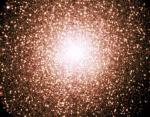 Globular Cluster 47 Tucanae from SALT
5.09.2005
Stars come in bunches. Of the over 200 globular star clusters that orbit the center of our Milky Way Galaxy, 47 Tucanae is the second brightest globular cluster, behind Omega Centauri. Known to some affectionately as 47 Tuc or NGC 104, it is only visible from Earth's Southern Hemisphere.
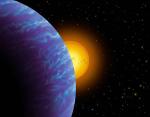 The Decade that Defined Star System
29.12.1999
As the 1990s began, the only planetary star system known was our own Solar System. The first extra-solar star system was discovered orbiting a pulsar in 1991. Slight changes in the precise arrival times of the pulses from the central small dense neutron star gave evidence of orbiting planets.
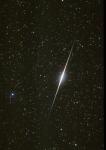 Iridium 52: Not A Meteor
22.10.1999
While hunting for meteors in the night sky above the White Mountains near Bishop, California, astrophotographer James Young instead captured this brilliant celestial apparition. Recorded near twilight on August 13, the bright streak is not the flash of a meteor trail but sunlight glinting from a satellite.
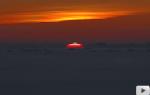 Movie: A Green Flash Over Italy
29.01.2007
How could the Sun turn green? Difficult to observe, the momentary green flash above the rising or setting sun has been documented as a phenomenon caused by the atmospheric bending or refraction of sunlight.
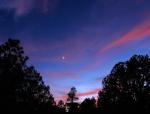 Red, White, and Blue Sky
4.07.2007
Contrasting colors in this beautiful sunset sky were captured on June 30 from Clear Creek Canyon Observatory in central Arizona, USA. The twilight scene includes brilliant Venus as the evening star, with a bright Saturn just above it, shining through thin clouds.
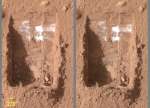 Vanishing Act
21.06.2008
Compare these two close-up pictures taken on sol 20 (left) and sol 24 of a trench dug in the Martian surface by NASA's Phoenix Lander. Those sols of the Phoenix Mission (a sol is a Martian day), correspond to June 15 and 18 on planet Earth.
|
January February March April May June July August September October |
|||||||||||||||||||||||||||||||||||||||||||||||||