
|
You entered: Earth
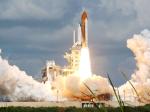 America Returns to Space Flight
27.07.2005
NASA's launch of the massive Space Shuttle Discovery yesterday brought a nation known for its tremendous space program back to human space flight. Shuttle flights had been suspended for over two years previously following the tragic loss of the Space Shuttle Columbia crew on 2003 February 1.
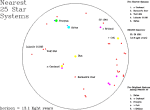 The Nearest Stars
21.04.1999
Which stars are closest to the Sun? The closest is Proxima Centauri, one of three stars that orbit each other about 4 light-years away in the Alpha-Centauri system. Alpha Centauri is easily visible from Earth's Southern Hemisphere. Next is Barnard's Star, a dim star visible with a telescope in the constellation of Ophiuchus.
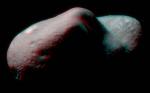 Stereo Eros
24.02.2000
Get out your red/blue glasses and float next to asteroid 433 Eros, 260 million kilometers away! Orbiting the Sun once every 1.8 earth-years, asteroid Eros is a diminutive 40 x 14 x 14 kilometer world of undulating horizons, craters, boulders and valleys.
 A Year of Extraterrestrial Fountains and Flows
31.12.2006
The past year was extraordinary for the discovery of extraterrestrial fountains and flows -- some offering new potential in the search for liquid water and the origin of life beyond planet Earth.. Increased evidence was uncovered that fountains spurt not only from Saturn's moon Enceladus, but from the dunes of Mars as well.
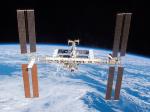 The International Space Station Expands Again
25.06.2007
The developing International Space Station (ISS) has changed its appearance again. During the past week, the Space Shuttle Atlantis visited the ISS and added pieces of the Integrated Truss Structure that mirrored those added in September 2006, including a second impressively long array of solar panels.
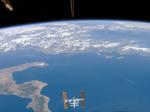 Space Station Over the Ionian Sea
27.11.2007
Last August, the Space Shuttle Endeavor crew captured this shot of the International Space Station (ISS) against the backdrop of Planet Earth. During that trip to the ISS, the space shuttle crew re-supplied the station, repaired the station, and even built more of the station.
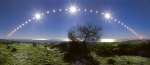 Tyrrhenian Sea and Solstice Sky
22.12.2007
Today the Solstice occurs at 0608 Universal Time, the Sun reaching its southernmost declination in planet Earth's sky. Of course, the December Solstice marks the beginning of winter in the northern hemisphere and summer in the south.
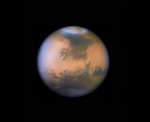 Dust Storm on Mars
5.02.2010
It's spring for the northern hemisphere of Mars and spring on Mars usually means dust storms. So the dramatic brown swath of dust (top) marking the otherwise white north polar cap in this picture of the Red Planet is not really surprising.
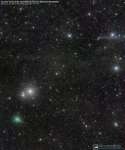 A Conjunction of Comets
23.09.2017
A conjunction of comets is captured in this pretty star field from the morning of September 17. Discovered in July by a robotic sky survey searching for supernovae, comet C/2017 O1 ASASSN is at the lower left. The visible greenish glow of its coma is produced by the fluorescence of diatomic carbon molecules in sunlight.
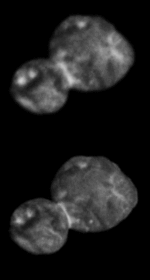 Ultima Thule Rotation Gif
4.01.2019
Ultima Thule is the most distant world explored by a spacecraft from Earth. In the dim light 6.5 billion kilometers from the Sun, the New Horizons spacecraft captured these two frames 38 minutes apart as it sped toward the Kuiper belt world on January 1 at 51,000 kilometers per hour.
|
January February March April May June July August September October |
|||||||||||||||||||||||||||||||||||||||||||||||||