
|
You entered: Earth
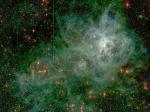 30 Doradus: The Tarantula Nebula
26.10.1999
30 Doradus is an immense star forming region in a nearby galaxy known as the Large Magellanic Cloud. Its spidery appearance is responsible for its popular name, the Tarantula Nebula, except that this tarantula is about 1,000 light-years across, and 165,000 light-years away in the southern constellation Dorado.
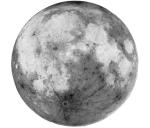 Full Moondark
28.07.2007
The brilliant full Moon might not look quite like this to skygazers next Monday, but the image is a mosaic of 18 digital frames recorded when the Moon was only about seven hours past its exact full phase or time of maximum illumination as viewed from Earth.
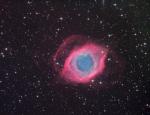 NGC 7293: The Helix Nebula
3.08.2007
A mere seven hundred light years from Earth, in the constellation Aquarius, a sun-like star is dying. Its last few thousand years have produced the Helix Nebula (NGC 7293), a well studied and nearby example of a Planetary Nebula, typical of this final phase of stellar evolution.
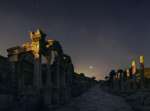 Jupiter over Ephesus
18.07.2008
A brilliant Jupiter shares the sky with the Full Moon tonight. Since Jupiter is near opposition, literally opposite the Sun in planet Earth's sky, Jupiter will rise near sunset just like the Full Moon.
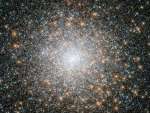 Globular Cluster M15 from Hubble
19.11.2013
Stars, like bees, swarm around the center of bright globular cluster M15. This ball of over 100,000 stars is a relic from the early years of our Galaxy, and continues to orbit the Milky Way's center.
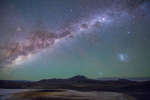 Galaxies from the Altiplano
13.10.2016
The central bulge of our Milky Way Galaxy rises over the northern Chilean Atacama altiplano in this postcard from planet Earth. At an altitude of 4500 meters, the strange beauty of the desolate landscape could almost belong to another world though.
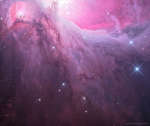 M43: Orion Falls
12.12.2018
Is there a waterfall in Orion? No, but some of the dust in M43 appears similar to a waterfall on Earth. M43, part of the Orion Molecular Cloud Complex, is the often imaged but rarely mentioned neighbor of the more famous M42.
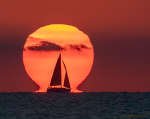 Omega Sunrise
21.09.2020
Capturing this sunrise required both luck and timing. First and foremost, precise timing was needed to capture a sailboat crossing right in front of a rising Sun. Additionally, by a lucky coincidence, the background Sun itself appears unusual -- it looks like the Greek letter Omega (н).
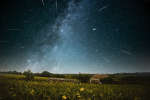 Three Perseid Nights
20.08.2021
Frames from a camera that spent three moonless nights under the stars create this composite night skyscape. They were recorded during August 11-13 while planet Earth was sweeping through the dusty trail of comet Swift-Tuttle.
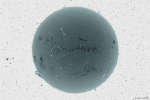 Dark Ball in Inverted Starfield
6.11.2022
Does this strange dark ball look somehow familiar? If so, that might be because it is our Sun. In the featured image from 2012, a detailed solar view was captured originally in a very specific color of red light, then rendered in black and white, and then color inverted.
|
January February March April May June July August September October |
|||||||||||||||||||||||||||||||||||||||||||||||||